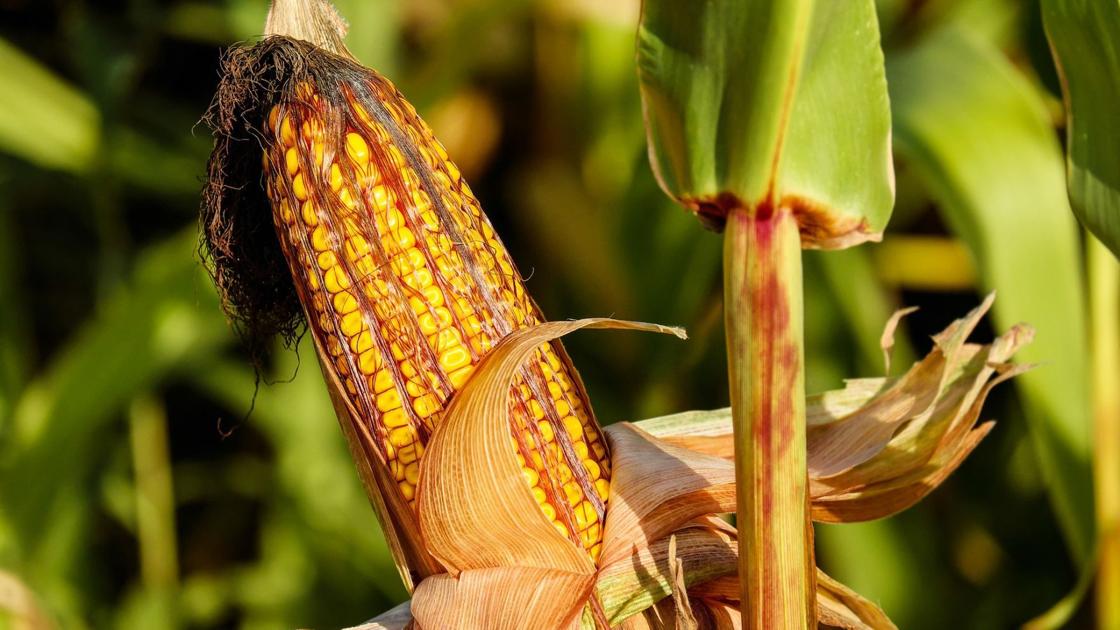
It may sound corny, but University of Missouri Extension state agronomist Bill Wiebold says corn ears can tell us why yields are down.
Corn ears show what went wrong during pollination and fertilization, the most critical time of yield establishment.
The ear's hard work makes kernels for high yields and profits.
Before pollination, the ear collects 1,000 female flowers. The structure that will become a kernel, if all goes well, is an ovule. One silk attaches to each ovule.
Just prior to stage R1, all 1,000 silks jump into action. They elongate under the husks and emerge. When timing is correct, pollen sheds from the tassel onto the silks. Then pollen grains and pollen tubes begin a courtship dance of sorts. The pollen grains germinate and pollen tubes grow inside the silks all the way to the ovule. Male and female sex cells called gametes then merge to make kernels.
"It's an amazing process, but in a good year, it successfully happens 15 to 20 million times in each acre of corn," Wiebold said.
But sometimes things go awry, resulting in poor tip fill or unfilled ear tips.
Silk elongation slows if there is limited water available. Tassels develop at a normal pace, but silks may emerge too late to receive pollen shed. Tip silks are the last to emerge and may be the most likely to miss pollen. Silks that stay attached at the tip indicate fertilization did not happen, and as a result, kernels do not grow.
Sometimes fertilization occurs, but developing kernels abort or stop growing because of competition between kernels for sugars, minerals and water or from drought stress interrupting photosynthesis and causing leaf stomates to close and leaves to roll. Agronomists refer to the symptoms of these problems as "tip dieback" or "tipback." Some dieback is normal when seeding rates are managed for maximum yield. Tipback may be visible and shows that there are enough ears for the highest yield.
AgrAbility Virtual State Fair
AgrAbility projects from 19 states, including Missouri, are part of this month's AgrAbility Virtual State Fair.
The event offers help for farmers, ranchers and other agricultural workers with disabilities or chronic health conditions, said Karen Funkenbusch, state director of the Missouri AgrAbility Project and a University of Missouri Extension health and safety specialist.
Throughout October, AgrAbility state projects will highlight farmers and ranchers through "Cultivating Accessible Agriculture." Missouri farmers and ranchers are featured on Wednesday, Oct. 7.
Short videos on Facebook and Twitter will highlight the latest assistive technologies, resources and safety tips.
The AgrAbility Virtual State Fair coincides with the 75th annual National Disability Employment Awareness Month and the 30th anniversary of the Americans With Disabilities Act.
Follow the event on Facebook (@AgrAbility Virtual State Fair) or Twitter (@AgrAbilityVSF), and read stories about people who benefitted from AgrAbility services at AgrAbility.org/25years.
AgrAbility also serves veterans, beginning farmers and underserved and disadvantaged populations.
More information about Missouri's program is available online at AgrAbility.missouri.edu and by calling 800-995-8503.
October 05, 2020 at 05:42AM
https://ift.tt/33yhUSI
Corn ears tell story of crop | Farm and Field | whig.com - Herald-Whig
https://ift.tt/3gguREe
Corn


No comments:
Post a Comment