Last spring, in the middle of Michigan’s stay-at-home order, I had a mild panic attack thinking I might not be able to purchase started tomato plants at the local garden center. In response to my concern I illicitly slipped into the off-limits gardening aisle at Meijer’s and purchased a packet of Burpee’s Long Keeper tomato seeds in the event nurseries and garden centers would either be closed due to the COVID pandemic, or, if open, have a limited selection of plants to choose from.
It turned out to be the latter, and while I was able to make my usual purchase of 16 Early Girl tomatoes and a few other varieties, plant selection proved to be rather limited. Meanwhile, back in early spring lockdown land I had planted a dozen pots of Long Keeper seeds and nurtured them in our sunny bay window until outdoor conditions were favorable in late May to set out all of my tomatoes — both started from seed and purchased plants.
I soon realized in my zeal to guarantee fresh tomatoes come August I had planted way too many of the sun-ripened juicy orbs of fruity (you are aware tomatoes are considered a fruit, not a vegetable, right?) goodness. Well I certainly wasn’t going to pull up the plants I had just surrounded with finished compost and a handful of organic fertilizer was I?
Nope. I weeded and nourished and pampered those three dozen tomato plants through the months of June and July and was rewarded with my first plump vine-ripened tomato in early August. It was followed by another and another and so on and so on. I made a batch of salsa with some of my tomatoes and then made two more with my youngest daughter, who for the past two years had helped me make homemade spaghetti sauce which we then shared for use during the long winter months.
Seeing that there were still a lot of green and partially ripened tomatoes to be had in September I came up with the idea to include my oldest daughter and then my son in this year’s spaghetti sauce making venture. They were agreeable to the idea and so as half bushels of the shiny red fruits ripened I stowed them away in the freezer for the day they could be turned into saucy goodness.
Because of COVID, our annual fall family get-together in October, when we would normally attend the Gaylord Elk’s pumpkin patch giveaway, was not in the cards for this family of 11; including three grandchildren — two of which were booked solid through the month with soccer games. We decided to move sauce making to my eldest daughter’s house near Midland and soccer, and to do our own pumpkin patch with those harvested from my garden.
The weekend in question proved to be remarkably conducive to sauce making and fall harvesting fun. Weather wise you couldn’t ask for better back-to-back days and fall color for a get-together.
Everyone pitched in chopping thawed and recently ripened tomatoes, along with onions and green peppers from the garden; adding herbs and garlic and olive oil to the mixture which was then ladled into a half dozen crock pots and a huge stovetop pot to cook and simmer and bubble for hours on end until ready for canning in my trusty pressure cooker.
By my reckoning we had transformed a bunch of tomatoes and other vegetables from the garden into eight gallons of homemade spaghetti sauce. We of course made much more than a boatload of sauce that weekend. We made a boatload of memories to last a lifetime.
When thinking of 2020, cocktails may not be the first thing to come to your mind. Still it’s cocktail’o clock at the moment – cocktail tomatoes that is. Even though the European tomato prices in the traditional season have been unfavorable, the cocktail segment has been a positive exception. Is it an effect of the COVID outbreak and people paying more attention to their food? “Could be, but the cocktail segment has grown for many years now”, says Wilfred Scheffers with Plantfactory, in charge of the marketing and sales of TomaTech tomato varieties in Northern Europe.
“The acreage of cocktail tomatoes in the Netherlands alone has grown to almost 200 hectares over the last years. The market seems positive for this growth and we foresee further expansion”, Wilfred says. This year the tomato prices in the traditional, unlit season haven’t been good at all and especially for bulk tomatoes the prices have been low. Products in a higher segment, like cocktail, have been a positive exception. “There’s a demand for more flavorful, high quality tomatoes”, he adds. “Cocktail tomatoes are an answer to this demand and people are willing to pay a higher price per kilo for this type of tomato, that of course also comes with a higher cost price.”
Wilfred believes further expansion of the acreage is possible – although it should of course be controlled. “You need to think of your market when starting to grow cocktail tomatoes and should not do it without proper sales channels. It’s like the snacking segment – growing those without having your sales organised is asking for a disaster – yet there’s growth potential for this segment.” According to him, the development of cocktail tomatoes itself is also in full swing. With Plantfactory he’s responsible for the marketing and sales of the tomato varieties of the Israeli breeding company TomaTech, and they’re answering to the developments in the market with varieties that are high in flavor.
TT750
A remarkable introduction in the cocktail segment is the Cosmopolitan (TT750). “A dark red, shiny cocktail of 55-60 grams with strong green parts. The yield numbers are remarkable – we've seen up to 10-15% higher yields than the nearest competitor – but even more remarkable is the positive bite and the flavorful, high brix of 7. The fruits are solid and the shelf life is above expectations, making it the best salad tomato currently available.” The variety is currently being tested all across Europe and in America, and the responses are very positive. “Germany, Austria, Italy, Netherlands...”, Wilfred sums up. “Of course it’s still trials, but it perfoms very well compared to the main variety. The genetics are strong for this one, with the flavor being exceptional.” Trials are currently also conducted in the lighted cultivation.
TT818
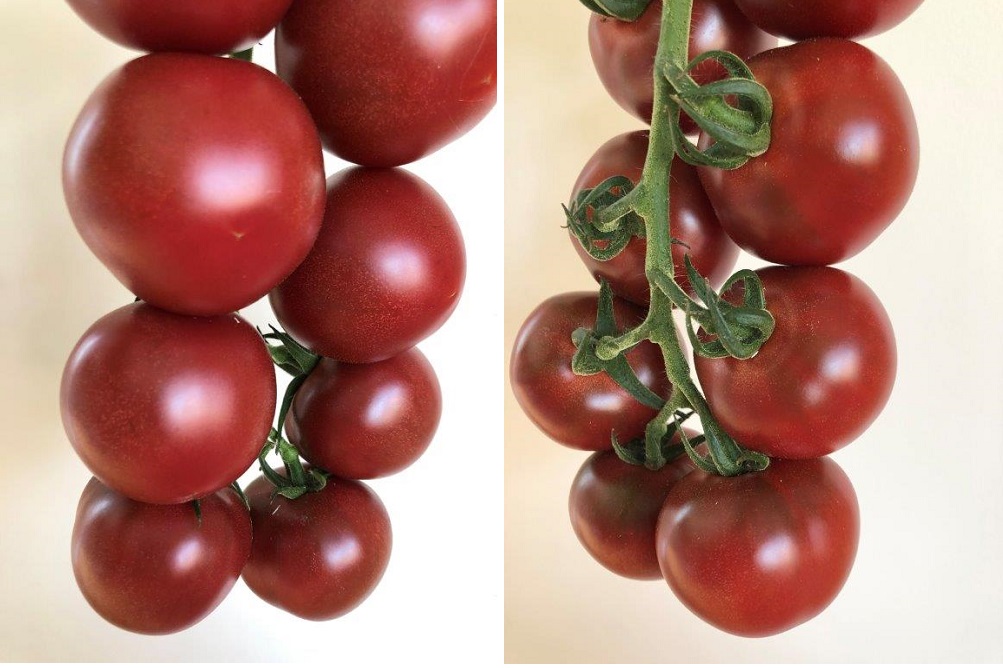
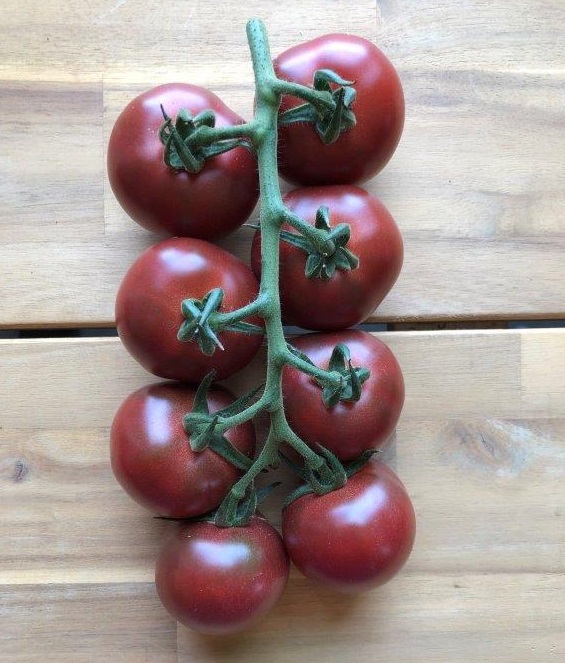
Whether it will be the Pina Colada, Jawbreaker or Screwdriver hasn’t been deciced, but the TT818 is another remarkable variety from the TomaTech portfolio. “Although we might better describe it as the Reserva wine under the tomatoes”, Wilfred laughs, referring to the aromatic, herby flavor of the tomato. But before you get to taste this one, it’s the color that attracts attention: when ripe, it’s a violet/purple variety. “A beautiful contrast since also the green parts are high in color and strong in quality. The growth is very consistent and the fruits are high in lycopene and strong against tearing. All in all it’s a beautiful, exclusive product.”
For those looking for an alternative to the standard red tomato, the TomViolet or the TomAmuse (Stoffels bvba) shape has some new surprises to bring as well. The pepper-shaped cherry TOV was introduced In Violet with the Stoffels farm in Belgium. almost three years ago and is now available in red, bright yellow and striking orange as well. “The taste is no less in these varieties than it is in the red one, and we hope to bring more commercial possibilities by expanding the assortment with these new colors. Boosting the range, so to say!”
You can almost feel sorry for pasta sauces that are not made with tomatoes. They are ignored, forgotten, belittled. Though endless in variety, they are like Rudolph the Red-Nosed Pasta: They don’t get to play any non-tomato pasta-sauce games.
So this week, I decided to take a look at these unsung heroes, the panoply of pasta sauces that are made without tomatoes.
I wanted the sauces I made to be quick and simple, too. Nothing too strenuous; I wanted them to be sauces you could whip up while you are getting the water ready to boil for the pasta.
Non-tomato sauces can be loaded with seafood, vegetables, nuts and herbs; they can be made with olive oil, butter and cream.
But I didn’t want to make my sauces with cream. Though cream is utterly delicious with pasta, it is also a little too easy. More to the point, it has more calories than I wanted to consume — especially considering I was going to be making five different kinds of pasta.
For my first fast and easy tomato-free pasta sauce, I made the fastest and easiest sauce there is. Spaghettini aglio e olio — Spaghettini With Oil and Garlic — is universal throughout Italy; it is perhaps the most comforting of all Italian comfort foods, a simple blend of olive oil, garlic, parsley, crushed red pepper and plenty of salty grated cheese.
According to the late famed cookbook author Marcella Hazan, Spaghettini With Oil and Garlic was created in Rome and quickly spread throughout the country. It was then, and still is now, a hugely popular late-night snack — but it also makes a fine lunch or dinner.
I next made a variation on that same dish, but the variation makes an enormous difference.
One of my favorite pasta sauces is made by dissolving anchovy fillets in hot olive oil. Spaghetti is tossed in the flavored oil, which gives it a rich and rounded briny flavor. Spaghetti With Capers takes that idea and adds a different kind of brininess, this time from capers.
The capers add a pungency to the dish, which is great if you, like me, love capers. But if you find the taste of capers unpleasant, you could leave them out and just make the spaghetti with anchovies.
Both are excellent, and don’t forget to serve them with Parmesan cheese. You might think that a salty cheese would be unnecessary with anchovies and capers, but it brings the flavors together. It is like sprinkling the dish with magic.
The most popular pasta sauce right now among those in the know is probably Cacio e Pepe. Made from cheese (cacio) and pepper (pepe) and very little else (olive oil), the sauce is ridiculously fast and easy to make.
You don’t even cook it. You mix together good cheese — the quality of the cheese counts with this dish — a healthy amount of ground pepper and olive oil. Then you stir in hot, just-cooked pasta and a little bit of the water you cooked it in.
That’s the whole dish. And it could not taste better.
For my next fast tomato-free pasta sauce, I went in a different direction. I went nuts.
Nutty Pasta isn’t even Italian; it is a French dish served most often in Provence. It is pesto with a twist. Instead of basil, it is made with parsley and mint (which is related to basil). Instead of pine nuts alone, it is made with pine nuts and almonds and pistachios.
Think of it: Pine nuts and almonds and pistachios ground together with parsley and mint. Add some olive oil and cheese, and you have something special.
And then there is the matter of the optional orange zest. A light sprinkling of orange zest makes a delightful citrus counterpoint to the richness of the nuts. If you ask me, it shouldn’t even be optional. But no one wants to hear about mandatory orange zest, I suppose.
The last sauce I made was the most complex, but it still takes no more time to make than it does to cook the pasta, if you count the time to bring the water to a boil.
Pappardelle with Broccoli Rabe and Mushrooms has a wonderfully fresh and unspoiled taste. A mixture of mushrooms is sauteed in oil that is flavored with garlic and fresh rosemary. Broccoli rabe, which is also known as rapini, is boiled separately, and then the wide noodles of pappardelle are cooked in the same broccoli rabe water.
Finally, everything is tossed together: the mushrooms, the broccoli rabe and the pasta, along with an inevitable sprinkling of good cheese. It is a dish that is hearty and satisfying.
Who needs tomatoes?
Spaghettini with Oil and Garlic, front, a pasta recipe without red sauce, photographed Wednesday, Oct. 21, 2020. (Hillary Levin/St. Louis Post-Dispatch/TNS)
Spaghettini With Oil and Garlic (Spaghettini Aglio e Olio)
1 pound spaghettini, vermicelli or thin spaghetti 5 tablespoons extra-virgin olive oil, divided 6 to 8 garlic cloves, peeled and sliced 1/2 teaspoon crushed red pepper, or more to taste 1/2 cup chopped fresh Italian parsley 1 cup freshly grated Grana Padano or Parmigiano-Reggiano cheese, optional
1. Bring a pot of salted water to a boil over high heat. Stir the spaghettini into the boiling water. Return to a boil, stirring frequently, and cook, semi-covered, until the pasta is tender but still very firm, about 6 minutes for spaghettini or vermicelli and 7 minutes for thin spaghetti.
2. Meanwhile, heat 3 tablespoons of the oil in a large skillet over medium heat. Add the garlic and cook, shaking the skillet, until pale golden, about 2 minutes. Remove from the heat, and add the crushed red pepper. Ladle about 1 1/2 cups of the pasta-cooking water into the sauce, then add the parsley, the remaining 2 tablespoons of olive oil 2 tablespoons of olive oil and salt to taste, and bring to a boil.
3. Fish out the pasta with a large wire skimmer or tongs and drop it directly into the sauce in the skillet. Bring the sauce and pasta to a simmer, tossing to coat pasta with sauce. Cook about 1 minute. Remove the skillet from the heat and toss in the grated cheese, if using. Check the seasoning, adding salt and crushed red pepper if necessary. Serve immediately in warm bowls. Serves 6.
Adapted from “Lidia’s Favorite Recipes” by Lidia Matticchio Bastianich and Tanya Bastianich Manuali.
Per serving: 443 calories; 17 g fat; 4 g saturated fat; 10 mg cholesterol; 15 g protein; 58 g carbohydrate; 2 g sugar; 234 mg sodium; 196 mg calcium
Cacio e Pepe, a pasta recipe without red sauce, photographed Wednesday, Oct. 21, 2020. (Hillary Levin/St. Louis Post-Dispatch/TNS)
Cacio e Pepe
1 pound pasta, your choice Salt 1 cup grated Pecorino Romano, plus more as needed for serving 1/2 cup extra-virgin olive oil 2 teaspoons black pepper, plus more if needed
1. Bring a large pot of salted water to a boil over high heat. Add the pasta and stir to submerge and separate the pieces. Cook uncovered until the pasta is just tender (al dente), according to the instructions on the package. Reserve about 1/2 cup of the pasta cooking water for finishing your sauce.
2. Drain the pasta in a colander. Pour the drained pasta into a heated serving bowl. Add the cheese, oil and pepper. Stir until the ingredients are evenly distributed. Add about 1/4 cup of the reserved cooking water to moisten the pasta slightly — it should appear creamy, not oily. If necessary, add a bit more of the pasta water.
3. Taste, and stir in more pepper if needed (pepper should be one of the main flavors). Serve immediately, with additional cheese on the side. Serves 6.
Adapted from “Pasta” by Gianni Scappin, Alberto Vanoli and Francesco Tonelli.
Per serving: 589 calories; 30 g fat; 9g saturated fat; 39 mg cholesterol; 22 g protein; 58 g carbohydrate; 2 g sugar; 3 g fiber; 935 mg sodium; 422 mg calcium
Pappardelle with Broccoli Rabe and Mushrooms
3 tablespoons olive oil 1 garlic clove, crushed 1 sprig rosemary, about 4 inches long 12 ounces mushrooms, preferably a variety, sliced 1 bunch of broccoli rabe (also called rapini), trimmed of tough stems 12 ounces dried pappardelle or dried egg fettucine 1/2 cup freshly grated Parmigiano-Reggiano cheese Salt and pepper to taste
1. Heat the olive oil in a heavy nonstick skillet over medium-high heat. Add the garlic and rosemary and cook until the garlic is fragrant and the rosemary starts to sizzle, about 1 1/2 minutes. Add the mushrooms and cook until they start to brown, about 10 minutes; shake the pan and stir often. Remove from the heat and keep warm.
2. Meanwhile, bring a large pot of salted water to a boil. Add the broccoli rabe and simmer until tender, about 5 minutes. Remove the broccoli rabe and set aside (keep the water boiling). Add the pasta to the same boiling water and cook until al dente, according to the instructions on the package. Drain the pasta, leaving a little water clinging to it.
3. Add the pasta, broccoli rabe and cheese to the skillet with the mushrooms and toss together. Season to taste with salt and pepper, and serve. Serves 4.
Recipe from “The Rose Pistola Cookbook” by Reed Hearon and Peggy Knickerbocker.
Per serving: 474 calories; 15 g fat; 3 g saturated fat; 7 mg cholesterol; 17 g protein; 67 g carbohydrate; 5 g sugar; 4 g fiber; 216 mg sodium; 144 mg calcium
Spaghetti with Capers, a pasta recipe without red sauce, photographed Wednesday, Oct. 21, 2020. (Hillary Levin/St. Louis Post-Dispatch/TNS)
Heat the oil in a pan, add the anchovy and garlic, and cook over low heat, stirring frequently, until the anchovies have dissolved and the garlic has turned golden brown. This will take several minutes. Remove the pan from the heat, discard the garlic and add the capers. Meanwhile, cook the spaghetti in a large pot of salted, boiling water until al dente, then drain, toss with the sauce and serve. Serves 4.
Adapted from “The Silver Spoon,” which has no listed author.
Per serving: 469 calories; 17 g fat; 3 g saturated fat; 12 mg cholesterol; 15 g protein; 64 g carbohydrate; 2 g sugar; 3 g fiber; 627 mg sodium; 55 mg calcium
Nutty pasta, a recipe without red sauce, photographed Wednesday, Oct. 21, 2020. (Hillary Levin/St. Louis Post-Dispatch/TNS)
Nutty Pasta
2 ounces almonds 2 ounces pine nuts 2 ounces shelled pistachios Leaves from 1 bunch parsley Leaves from 1 bunch mint 12 ounces spaghetti 3 tablespoons olive oil Parmesan cheese, for grating Zest from 1/2 orange, optional
1. Put the almonds, pine nuts, pistachio, parsley and mint into a food processor and chop until fine but not completely pulverized — it should still have a bit of texture.
2. Cook the spaghetti in boiling water until al dente, according to the package directions. Drain. Toss with the nut paste, olive oil, cheese and zest, if using. Serve immediately. Serves 6.
Adapted from “French Taste” by Laura Calder.
Per serving: 385 calories; 16 g fat; 2 g saturated fat; 1 g cholesterol; 13 g protein; 50 g carbohydrate; 3 g sugar; 5 g fiber; 30 mg sodium; 73 g calcium
You can almost feel sorry for pasta sauces that are not made with tomatoes. They are ignored, forgotten, belittled. Though endless in variety, they are like Rudolph the Red-Nosed Pasta: They don’t get to play any non-tomato pasta-sauce games.
So this week, I decided to take a look at these unsung heroes, the panoply of pasta sauces that are made without tomatoes.
I wanted the sauces I made to be quick and simple, too. Nothing too strenuous; I wanted them to be sauces you could whip up while you are getting the water ready to boil for the pasta.
Non-tomato sauces can be loaded with seafood, vegetables, nuts and herbs; they can be made with olive oil, butter or cream.
Spaghettini with Oil and Garlic, front, a pasta recipe without red sauce, photographed Wednesday, Oct. 21, 2020. (Hillary Levin/St. Louis Post-Dispatch/TNS)
SPAGHETTINI WITH OIL AND GARLIC (SPAGHETTINI AGLIO E OLIO)
1 lb. spaghettini, vermicelli or thin spaghetti
5 T. extra-virgin olive oil, divided
6 to 8 garlic cloves, peeled and sliced
1/2 t. crushed red pepper, or more to taste
1/2 c. chopped fresh Italian parsley
1 c. freshly grated Grana Padano or Parmigiano-Reggiano cheese, optional
Bring a pot of salted water to a boil over high heat. Stir the spaghettini into the boiling water. Return to a boil, stirring frequently, and cook, semi-covered, until the pasta is tender but still very firm, about 6 minutes for spaghettini or vermicelli and 7 minutes for thin spaghetti.
Meanwhile, heat 3 tablespoons of the oil in a large skillet over medium heat. Add the garlic and cook, shaking the skillet, until pale golden, about 2 minutes. Remove from the heat, and add the crushed red pepper. Ladle about 1 1/2 cups of the pasta-cooking water into the sauce, then add the parsley, the remaining 2 tablespoons of olive oil and salt to taste, and bring to a boil.
Fish out the pasta with a large wire skimmer or tongs and drop it directly into the sauce in the skillet. Bring the sauce and pasta to a simmer, tossing to coat pasta with sauce. Cook about 1 minute. Remove the skillet from the heat and toss in the grated cheese, if using. Check the seasoning, adding salt and crushed red pepper if necessary. Serve immediately in warm bowls. Makes 6 servings.
(Adapted from “Lidia’s Favorite Recipes” by Lidia Matticchio Bastianich and Tanya Bastianich Manuali.)
LEMON PASTA
12 oz. egg noodles
2 lemons
1 c. heavy cream
Salt and pepper
Heat a large pot of salted water to a boil, and add the noodles. Cook according to package directions until tender. Drain and return to pot.
Meanwhile, remove the zest from 1 lemon and cut into thin strips about 1 inch long. Juice both lemons. Pour the cream into a small saucepan, add the zest, season with salt and pepper, and bring to a boil over medium-high heat, about 2 minutes. Pour this sauce over the cooked noodles, add the lemon juice, and cook, stirring, until all of the liquid is absorbed. Taste, and add more salt and especially pepper, if desired. Makes 4 servings.
Cacio e Pepe, a pasta recipe without red sauce, photographed Wednesday, Oct. 21, 2020. (Hillary Levin/St. Louis Post-Dispatch/TNS)
CACIO E PEPE
1 lb. pasta, your choice
Salt
1 c. grated Pecorino Romano, plus more as needed for serving
1/2 c. extra-virgin olive oil
2 t. black pepper, plus more if needed
Bring a large pot of salted water to a boil over high heat. Add the pasta and stir to submerge and separate the pieces. Cook uncovered until the pasta is just tender (al dente), according to the instructions on the package. Reserve about 1/2 cup of the pasta cooking water for finishing your sauce.
Drain the pasta in a colander. Pour the drained pasta into a heated serving bowl. Add the cheese, oil and pepper. Stir until the ingredients are evenly distributed. Add about 1/4 cup of the reserved cooking water to moisten the pasta slightly — it should appear creamy, not oily. If necessary, add a bit more of the pasta water.
Taste, and stir in more pepper if needed (pepper should be one of the main flavors). Serve immediately, with additional cheese on the side. Makes 6 servings.
(Adapted from “Pasta” by Gianni Scappin, Alberto Vanoli and Francesco Tonelli.)
PAPPARDELLE WITH BROCCOLI RABE AND MUSHROOMS
3 T. olive oil
1 garlic clove, crushed
1 sprig rosemary, about 4 inches long
12 oz. mushrooms, preferably a variety, sliced
1 bunch broccoli rabe (also called rapini), trimmed of tough stems
12 oz. dried pappardelle or dried egg fettucine
1/2 c. freshly grated Parmigiano-Reggiano cheese
Salt and pepper to taste
Heat the olive oil in a heavy nonstick skillet over medium-high heat. Add the garlic and rosemary, and cook until the garlic is fragrant and the rosemary starts to sizzle, about 1 1/2 minutes. Add the mushrooms and cook until they start to brown, about 10 minutes; shake the pan and stir often. Remove from the heat and keep warm.
Meanwhile, bring a large pot of salted water to a boil. Add the broccoli rabe and simmer until tender, about 5 minutes. Remove the broccoli rabe and set aside (keep the water boiling). Add the pasta to the same boiling water and cook until al dente, according to the instructions on the package. Drain the pasta, leaving a little water clinging to it.
Add the pasta, broccoli rabe and cheese to the skillet with the mushrooms and toss together. Season to taste with salt and pepper, and serve.
(Recipe from “The Rose Pistola Cookbook” by Reed Hearon and Peggy Knickerbocker.)
Spaghetti with Capers, a pasta recipe without red sauce, photographed Wednesday, Oct. 21, 2020. (Hillary Levin/St. Louis Post-Dispatch/TNS)
SPAGHETTI WITH CAPERS
4 T. olive oil
2 or 3 anchovy fillets
2 garlic cloves, peeled but whole
2 T. capers, rinsed
12 oz. spaghetti
Heat the oil in a pan, add the anchovy and garlic, and cook over low heat, stirring frequently, until the anchovies have dissolved and the garlic has turned golden brown. This will take several minutes.
Remove the pan from the heat, discard the garlic and add the capers. Meanwhile, cook the spaghetti in a large pot of salted, boiling water until al dente, then drain, toss with the sauce and serve. Makes 4 servings.
(Adapted from “The Silver Spoon,” which has no listed author.)
Nutty pasta, a recipe without red sauce, photographed Wednesday, Oct. 21, 2020. (Hillary Levin/St. Louis Post-Dispatch/TNS)
NUTTY PASTA
2 oz. almonds
2 oz. pine nuts
2 oz. shelled pistachios
Leaves from 1 bunch parsley
Leaves from 1 bunch mint
12 oz. spaghetti
3 T. olive oil
Parmesan cheese, for grating
Zest from 1/2 orange, optional
Put the almonds, pine nuts, pistachio, parsley and mint into a food processor and chop until fine but not completely pulverized — it should still have a bit of texture.
Cook the spaghetti in boiling water until al dente, according to the package directions. Drain. Toss with the nut paste, olive oil, cheese and zest, if using. Serve immediately. Makes 6 servings.
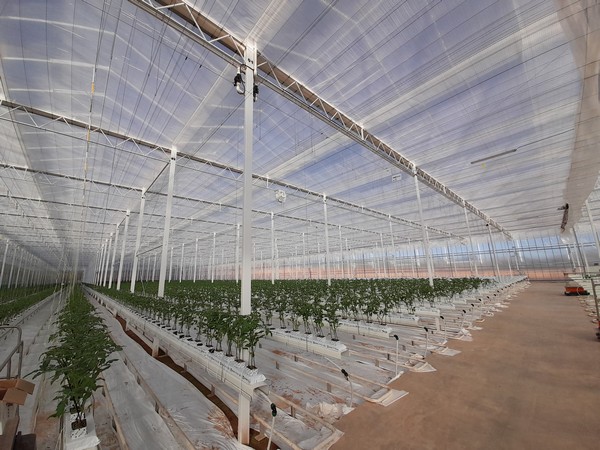
In early spring, turnkey greenhouse constructor Havecon already brought Fonte Verde Agro to our attention, a remarkable greenhouse horticulture project. In Andradas, the southern region of Mina Gerais near São Paulo, Brazil, a 2-hectare greenhouse has been built, of which more than 1.5 hectares are planned for the cultivation of tomatoes. Havecon was chosen to supply all the materials for this remarkable project.
In addition to the greenhouse, the rest of the facility was taken care of by well-known Dutch companies. For example, VB supplied the heating system, and FDG Systems in Den Hoorn supplied the water treatment units. Priva supplied the Connext process computer, and Erfgoed in Moerkapelle took care of the cultivation floors and leveling the plot. Doek en Draad in 's-Gravenzande supplied the screens.
High-tech cultivation in challenging conditions
The use of advanced Dutch materials, technology, and expertise, allow for the realization of protected cultivation at Fonte Verde. For example, the temperature and ventilation in the greenhouse can be adjusted throughout the year, there is organic crop protection, and all the water is reused through a closed-loop system.
This way the tomatoes are 99% pesticide-free. By doing this Fonte Verde Agro makes an important contribution to food security and quality in this part of South America. Grower Arjan Kouwenhoven has mentioned this before: "It's not as easy as it looks here, but the quality of the tomatoes in the stores certainly offers possibilities. We want to see if we can cultivate with a biological balance, as is done in the Netherlands, using a glass greenhouse and all the available high-tech facilities. If we succeed, we can serve as an example and certainly involve local growers in our process."
Milestone
CombiCoop in Maasdijk oversaw the entire purchase and project management for Fonte Verde Agro. CEO Arjan Flikweert is looking at an important milestone: "It took some effort, but as a team, we are extremely proud to report that the first self-grown tomato plants are on the gutter.”
Flikweert adds: "With this, an advanced greenhouse, in an even more remarkable place, is officially operational. And we are incredibly proud of that. I want to thank all the partners, including Havecon, for realizing this exceptional project together!"
See the first pictures from Brazil above. Be sure to take a look at the website: www.fonteverdeagro.com.br
It's the size of a blueberry but it is bright red and shiny - like a tomato. And indeed - it is a tomato that Ben Meadows is holding in his hand. It's the Tomberry, a Dutch innovation that he brought to Australia in conjunction with our specialist plant propagation nursery partner Trandos Hydroponics, and is now marketing. "The take-up of Tomberry from retailers and consumers in Australia has been beyond our expectations. This gives us the ability to quickly scale up production and develop the Tomberry range," Ben says.
A novelty in this supermarket down-under!
Innovation "Our growers need a variety that can deliver consistent great quality and flavour. That same variety also has to be profitable and deliver agronomic benefits to the grower. It's very hard to get the balance right, often the best varieties are difficult and expensive to grow," Ben explains. He's with Edison, an Australian intellectual property and product commercialisation business that currently has a number of exclusive varieties that are licensed to major supermarkets and glasshouse growers in Australia and New Zealand. "We focus on sustainably grown glasshouse varieties. We look for varietal traits that improve the product offer to both growers and consumers."
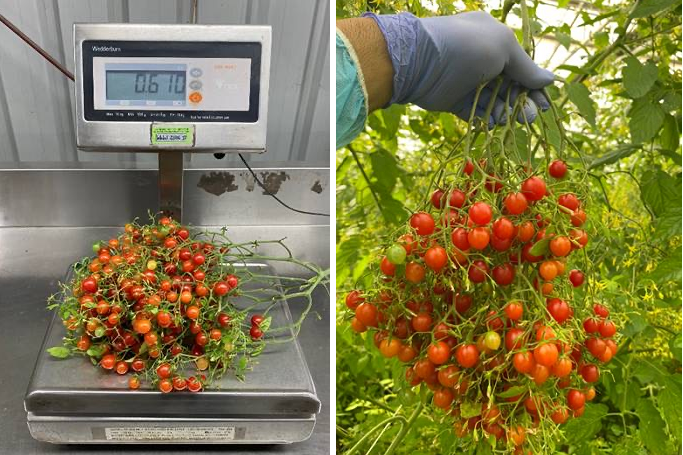
Recently the company launched a new micro ‘EXTREME’ snacking range and the Tomberry is the first product in it. Tomberry is a naturally bred variety by Eminent Seeds in Holland and is the Worlds smallest tomato. All Australian Tomberry is grown in environmentally sustainable greenhouses where they are 90% more water efficient than traditional growing methods. "The glasshouses also help protect these little gems from Australia’s harsh climatic conditions," Ben says. "The plant behaves similar to a standard glasshouse tomato on the vine (TOV). The key difference is that each truss has 250 Tomberry ‘berries' opposed to 5 large Tomatoes," Ben says. "Tomberry is a unique product weighing between half a gram to 2 grams - the size of a blueberry and a tomato that packs a much bigger nutritional punch."
Added to meals Ben explains how Tomberry can be added to many meals to make them healthy, add flavour and colour. "These little tomatoes actually pop in your mouth adding a great textural element to your dishes. It’s a “NO CHOP” tomato that is very versatile and can be used as a Fresh Snack, or in Salads, Stews and Soups or on Pizza’s and Pasta’s. Then, Tomberry is also very snack-able and great in lunch boxes. In addition, Tomberry is high in lycopene, vitamin A & vitamin C, a good source of fiber, high in antioxidants and cholesterol free."
A combination like this is exactly what the Edison team wants in their product range. "All in all, it's a variety that suits the Edison team very well and that we wanted to offer to our customers."
At Edison they see enormous opportunity in Australia for Tomberry in food service also. "The taste is great, but the unique micro size is the tipping point that has given Tomberry the thumbs up by chefs and customers. With Tomberry's ability to dress-up a plate, add excitement and style and deliver that flavour pop when eating we think it's made for the restaurant market."
And it turned out they were right: The take-up of Tomberry from retailers and consumers in Australia has been beyond their expectations. The team is quickly expanding production of their wonderful ‘little’ tomato to keep up with demand.
"The success gives us the ability to quickly scale up production and develop the Tomberry range. This gives us plenty of options to expand the Tomberry offer in the future," Ben concludes. And there's more to come. The next micro snacking products coming through Edison's trial program is Tinker-bell micro blocky capsicums and new colour variants of Tomberry Tomatoes including chocolate, orange and pink. "I’m really excited to see this Tomberry Carnival range hit the shelves very soon."
For more information:
Ben Meadows Edison 126 Torquay Road
Grovedale Geelong
Victoria 3216 Australia ben@edison.net.au
+61 488 111 160 www.edison.net.au
FOSTORIA, OH (Oct. 29, 2020) – AgCredit, a cooperative lender to 18 counties in Northern Ohio, donated more than 6,100 cans of tomato sauce to the West Ohio Food Bank, Toledo Northwestern Ohio Food Bank and Second Harvest Food Bank of North Central Ohio as part of its ongoing corporate mission to help residents suffering from food insecurity.
AgCredit’s “Sharing the Harvest by Giving Thanks” campaign is an initiative that provides canned and nonperishable food items to the region’s food banks to help address the hunger and nutritional needs of area residents. Canned tomato products are some of the most prized donations received by food banks because they present high-quality produce in a shelf-stable form that is convenient for food bank clients and make fresh, healthy food more affordable.
“We credit the Toledo Northwest Ohio Foodbank, West Ohio Foodbank in Lima and Second Harvest Food Bank of North Central Ohio for their tireless work and are delighted to support their efforts by donating a pallet of Dei Fratelli tomato sauce on behalf of our farmer members,” AgCredit Board of Directors Chairman Dusty Sonnenberg said.
Donation by the numbers:
• DeiFratelli tomato sauce – 15 oz. can
• Serving size – ¼ of cup
• Servings per container – 7
• Case – 12 cans
• Each food bank – 170 cases (510 total cases)
• Total cans per food bank – 2,040 (6,120 total cans)
• Total servings – 14,280 (42,840 total servings)
Tomatoes, the state fruit of Ohio, are produced in many North Central and Northwest Ohio counties AgCredit serves. This donation aligns with the Association’s commitment to support rural communities, ag producers, agribusinesses and rural homeowners.
“Dei Fratelli tomato sauce is made by Hirzel Canning in Pemberville from tomatoes grown by our member-borrowers and other Ohio farmers,” Sonnenberg said. “Our ‘Sharing the Harvest’ campaign enables AgCredit customers to help meet the basic needs of their neighbors at a time when many are struggling.”
About AgCredit
AgCredit is a cooperative lender and proud member of the Farm Credit System, which was created over 100 years ago to provide a reliable source of credit for the nation’s farmers and ranchers. AgCredit supports rural communities and agriculture with reliable, consistent credit and financial services. For more information about AgCredit or its “Sharing the Harvest by Giving Thanks” campaign,, visit AgCredit.net.
Oakes Farms offers a diversified portfolio of services that reach a global market that include farming, packing, shipping, retail markets and foodservice and seafood distribution.
The company plants, grows and harvests more than 100 fruits and vegetables and collaborates with regulated growers on all continents to negotiate year-round produce fulfillment orders. Its customer base is approximately 40 percent direct to retail, 40 percent direct to foodservice and 20 percent to wholesalers and terminal markets.
“We have over 2,000 acres of crops in Florida between Immokalee, Plant City and Naples,” said Steve Veneziano, vice president of the Immokalee, FL-based company. “Among our products are watermelon, eggplant, squash, and the full gamut of peppers.”
Oakes Farms started growing in Florida eight years ago with 56 acres and built really aggressively over that time.
“Our strategy is to focus on quality, not costs, and that has allowed us to grow so fast,” Veneziano said. “We’re grading harder than our competition and putting up ultra-premium packs and spending all the money in the farm. We’re not skipping any corners. We are going all-in and trying to do the right thing.”
The company’s grower/packer/shipper division currently operates out of five state-of-the-art industrial buildings that encompass more than 138,000 square feet and has a fleet of 37 temperature-controlled semi-trucks, and more than 1,000 independent truck drivers that deliver hundreds of farm-grown commodities between distribution points across the United States.
Despite the pandemic, things have been running smoothly in 2020.
“We’re not having any interruption of service and sales are on the upswing,” Veneziano said. “There’s a little less foodservice business but there’s a lot more retail business so things are positive.”
Oakes Farms has a philosophy of “seed to table,” and that has become even more important during COVID-19 times.
“It seems more than ever folks want to know where product is coming from. We’re trying to show them that we skip the middleman and can provide the product and market them all ourselves,” Veneziano said. “We’re able to tell the consumer where it’s from and we are proudly promoting Fresh From Florida and the logo on all of our boxes.”
Early indications on most crops are good, though he admitted the first planting is tougher than normal because there’s been a ton of rain in 2020. “Everything beyond the first planting is looking strong and we are really excited to move forward, Veneziano said.
A new program for the company this year is the vine-ripe tomato program, which it’s entering in a big way. Oakes Farms ramped up and hired multiple people for the new tomato program and plan to continue to build the team in a much larger way.
“That’s an exciting thing for us,” Veneziano said. “We just felt there was a need for an American-grown Florida ultra-premium vine-ripe tomato. We are going to be packing them in a high-graphic display box starting the second week of November. The lid of the box will have a very large American flag on it.”
Additionally, Oakes Farms is coming into the fall watermelon season strong. The spring was the company’s first time growing watermelon and it did about 300 acres and will do 70 acres in the fall.
“Next spring, we plan on 750 acres,” Veneziano said. “It’s some hefty increases there. Watermelon people are just eating healthier and there’s a strong demand for Florida watermelon, so we wanted to jump into the game.”
Other growth opportunities are planned for 2021 as well.
“We’re going to continue to look to expand our commodity list and continue to expand our growing regions,” Veneziano said. “Our sales growth is really strong. At this time, we are unable to add any new customers because that demand is so strong. Our goal is to expand to allow for new customers to come on board.”
This isn’t a column about tripe. But also, it is a column about tripe. Half honeycomb, half rug-that-has-been-forgotten-on-the-washing-line-in-the-rain, tripe, its form and function, is fascinating and precious. Despite changing habits, tripe remains pretty ordinary in Rome, even for those who don’t eat it. It is as much the part of a butcher’s counter or supermarket shelf as chicken, sausages, chops and minced beef. Seeing the honeycomb rug sitting in folds behind the curved glass counter, I am reminded of Fergus Henderson’s words at the start of his book Nose To Tail Eating. He explains that, given the book’s title, it would be disingenuous not to eat the whole beast; that there is a set of delights, textural and flavoursome, beyond the fillet. Quoting this isn’t to say I don’t have thoughts, many of them conflicting, about tripe, and about meat in general, but complicated thoughts about meat are useful, I think – now more than ever.
Also complicated are my thoughts about tripe’s texture – what Fuchsia Dunlop calls “the rubber factor” – but, again, this is an entirely welcome thing, the texture like rubbery cheese meeting velvet mushroom with a cartilage crunch. I like to think my love of it was passed on by my Lancastrian grandparents, who bought tripe from United Cow Products and ate it with vinegar.
As I have mentioned before, our part of Rome, Testaccio, with its mustard-yellow palazzi and grid of streets named after inventors and builders, is the old slaughterhouse district, and is inextricably linked with quintoquarto – fifth quarter cooking. That is, of offal. Tripe is a fixture on the menus of most trattorias, served alla Romana – boiled until tender, then braised with tomato and a wild herb called mentuccia (which tastes like the lovechild of mint, oregano, sage and a bit of cat pee, although don’t let that put you off), then finished with plenty of pecorino.
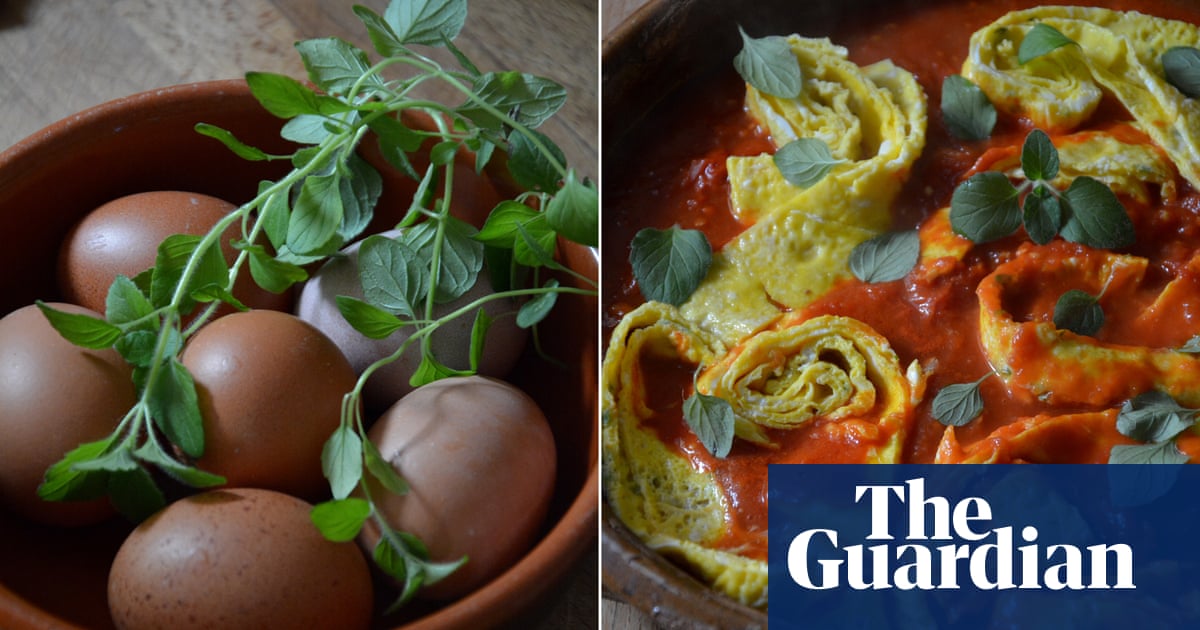
These days, like most offal, tripe is no longer cheap, and not everyone wants to eat it. Enter uova in trippa alla Romana – eggs cooked like tripe, Roman-style. Eggs are beaten, fried into slender omelettes, then rolled, sliced into thick ribbons and stirred into a rich tomato sauce, the effect of which is reminiscent of its sister dish. The taste, I assure you, is quite different; also, completely different from eggs cracked in tomato sauce (uova in purgatorio or shakshuka), the strips having a completely different feel – lively somehow, and gentle – and good-tasting in the way tomatoes and eggs always are.
If you want to make trippa alla Romana, omit the eggs, obviously. The tripe will need parboiling and then another 30 minutes or so in with the sauce, to which you can add mentuccia, if you can find it; alternatively, mint. Whether the version you make is or isn’t about tripe, it isn’t complicated. It also needs bread.
Eggs in tomato sauce (Uova in trippa alla Romana)
Serves 4
6 tbsp olive oil
1 garlic clove, peeled and sliced 800g tin of peeled plum tomatoes, milled or chopped 1 small, crumbled dried red chilli
1 handfulbasil leaves
Salt and black pepper
6 eggs
1 tbsp chopped mint or parsley
Pecorino or parmesan, to serve (optional)
Make the sauce by warming the oil and garlic over a medium-low heat, so the garlic fries gently. Add the tomatoes, chilli, basil and a pinch of salt, bring to an almost-boil, then reduce to a simmer for 15 minutes, or until rich and thick.
While the sauce simmers, prepare the egg omelettes. In a bowl, beat the eggs, parsley or mint, salt and pepper. Working in a nonstick pan, and using a third of the mixture each time, make three slim omelettes. Leave to cool, then roll into a log and cut into strips.
Once the sauce is ready, stir the egg strips into the tomato sauce, and serve with a sprinkling of pecorino or parmesan, if you like.
FOSTORIA – AgCredit, a cooperative lender to 18 counties in northern Ohio, donated more than 6,100 cans of tomato sauce to the West Ohio Food Bank, Toledo Northwestern Ohio Food Bank and Second Harvest Food Bank of North Central Ohio as part of its ongoing corporate mission to help residents suffering from food insecurity.
AgCredit’s “Sharing the Harvest by Giving Thanks” campaign is an initiative that provides canned and nonperishable food items to the region’s food banks to help address the hunger and nutritional needs of area residents.
Canned tomato products are some of the most prized donations received by food banks because they present high-quality produce in a shelf-stable form that is convenient for food bank clients and make fresh, healthy food more affordable.
“We credit the Toledo Northwest Ohio Foodbank, West Ohio Foodbank in Lima and Second Harvest Food Bank of North Central Ohio for their tireless work and are delighted to support their efforts by donating a pallet of Dei Fratelli tomato sauce on behalf of our farmer members,” AgCredit Board of Directors Chairman Dusty Sonnenberg said.
Donation by the numbers:
· DeiFratelli tomato sauce – 15 ounce can
· Serving size – ¼ of cup
· Servings per container – 7
· Case – 12 cans
· Each food bank – 170 cases (510 total cases)
· Total cans per food bank – 2,040 (6,120 total cans)
· Total servings – 14,280 (42,840 total servings)
Tomatoes, the state fruit of Ohio, are produced in many north central and Northwest Ohio counties AgCredit serves. This donation aligns with the Association’s commitment to support rural communities, ag producers, agribusinesses and rural homeowners.
“Dei Fratelli tomato sauce is made by Hirzel Canning in Pemberville from tomatoes grown by our member-borrowers and other Ohio farmers,” Sonnenberg said. “Our ‘Sharing the Harvest’ campaign enables AgCredit customers to help meet the basic needs of their neighbors at a time when many are struggling.”
After 7 months of a tomato season with many ups and downs, it's time to take a quick stock. "Eventually, we have exported more volumes than in 2019; however, the average prices have been lower, especially those of round tomatoes," says Guilhem Flammen, sales manager for France at the Hoogsteder society, a cooperative of fruit and vegetable producers set up in the Netherlands.
The lockdown in France has taken a huge toll on the catering sector throughout the season. Prices and the available volumes have inevitably been affected, especially those of round tomatoes. "As far as we are concerned, the good dynamics in the French supermarket sector have not had a sufficient impact on the demand and the prices of imported tomatoes, since the French production tends to be given priority. Besides, the impact of the virus was very limited in the Netherlands thanks to excellent management by all producer organizations."
A pretty good end to the season for Dutch producers
As for the end of the season, which took place over the past six weeks, it has been quite good for the producers. "The production shortages led to higher prices and we partially recovered from a difficult season. We expect this to continue, despite the lockdowns currently in place in many European countries. We will finish the season with the old harvest in week 47, but we will be ready to start the new harvest from week 46 to give our customers the best possible transition between the two productions."
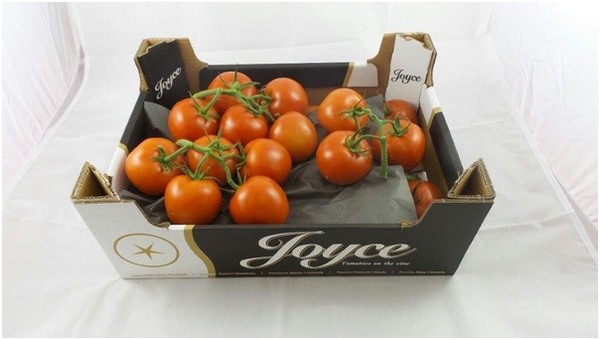
Joyce on the vine tomato, a Hoogsteder exclusive
The Joyce brand, exclusive to Hoogsteder
Very soon, Hoogsteder will offer the Joyce brand tomato, on which they'll hold exclusive rights this winter. "This tomato will be available until March. It is a product of excellent quality that guarantees stability throughout the winter period."
Today’s batch of burning questions, my smart-aleck answers and the real deal:
Question: I live in Horse Shoe, and every day I pass two tomato fields where recently all the stakes have been pulled out and all the plants are lying on the ground. There are literally thousands of tomatoes just lying there. I am amazed that no one has harvested them. It seems like they could at the very least been picked for tomato sauce or juice. Seems awful wasteful. This happens every year. What is up with that?
My answer: Or we could just divide up into political teams and have a massive rotten tomato fight in the field to work out all of our pent-up angst. Just a suggestion...
Real answer: Having lived in Edneyville when I first moved here and now living in Fletcher, I've noticed this phenomenon every year for a couple of decades, both with apples and tomatoes.
It's seems to make no sense, but as with most mysteries in life, it does have an explanation. On this one, I reached out to Karen Blaedow, a North Carolina Extension Service horticulture agent in Henderson County who specializes in commercial vegetables and small fruit.
I suggested all the torrential rain we've had this year may have played a role in making the 'maters unworthy of picking.
"You're exactly right — often after we have challenging weather conditions, such as all the rain in August and September, the tomato crop suffers from several physiological disorders such as cracking, uneven ripening, and rain check (another type of cracking)," Blaedow said. "These disorders cause the crop to be rejected by buyers or unfit for storage or shipping to grocery stores."
The fruit remaining in the fields comes down to simple economics.
"If the farmer can't sell these tomatoes to their usual buyers, they cannot afford to pay labor to pick them, so that is why you see tomatoes left unpicked in the field toward the end of the tomato season or following heavy rain/storm events," Blaedow said.
Some organizations in the mountain have "gleaning" operations, where they utilize the fruit.
"Some local farms work with organizations like the Society of Saint Andrews or Bounty & Soul to glean the unsold/unharvested tomatoes, but there are still several tomatoes left after gleaning that are either cracking or have started rotting, and those of course get left in the field," Blaedow said.
They would be ideal for a good old-fashioned tomato fight, though, I bet. But let's move on.
Blaedow brought up another good reason tomatoes will be left in the field, one I hadn't considered.
"In addition, when a tomato crop is damaged due to weather or environmental conditions and the farmer has crop insurance, they have to leave the tomatoes unharvested in the field in order to receive an insurance payment," Blaedow said.
Question: Could we get an update on the Sweeten Creek Road widening? First it was delayed, then COVID delayed any updates, and now there is the Busbee development coming on Sweeten Creek. When will we know?
My answer: It's safe to say this may happen before the 2020 election wraps up, and by that I mean sometime before 2050.
I also mentioned it this week in a story about the aforementioned Busbee development. The Buncombe County Board of Adjustment approved the 852-unit apartment complex on Sweeten Creek Road at its Nov. 5 meeting, and the project involved some discussion about Sweeten Creek widening.
The road in the area — just south of the Blue Ridge Parkway and across the street from the Carolina Day School athletic fields — is two lanes. Sweeten Creek is notorious for backups, especially in the Mills Gap Road intersection vicinity.
The developer will put two entryways for the Busbee development off Sweeten Creek, and the one by the athletic fields will get a new traffic light.
The Asheville office of the N.C. DOT said Nov. 5 it does still plan to widen Sweeten Creek, with right of way acquisition to begin in July 2023 and construction contracts going out in September 2028.
The holiday season is a weird time even under normal circumstances, but add in the pandemic and an election wherein votes will continue to trickle in until next week and — well, I've been thinking a lot about the concept of purgatory recently.
According to some Christian, specifically Roman Catholic, theology, purgatory is an intermediate state that exists between physical death and heaven. There you atone for and are cleansed from your attachment to your sins, before your soul's entrance into heaven. But my general impression as a kid who grew up going to Catholic school, I remember — especially after reading Dante's "Purgatorio" — thinking that it sounded like an awful lot of waiting.
Advertisement:
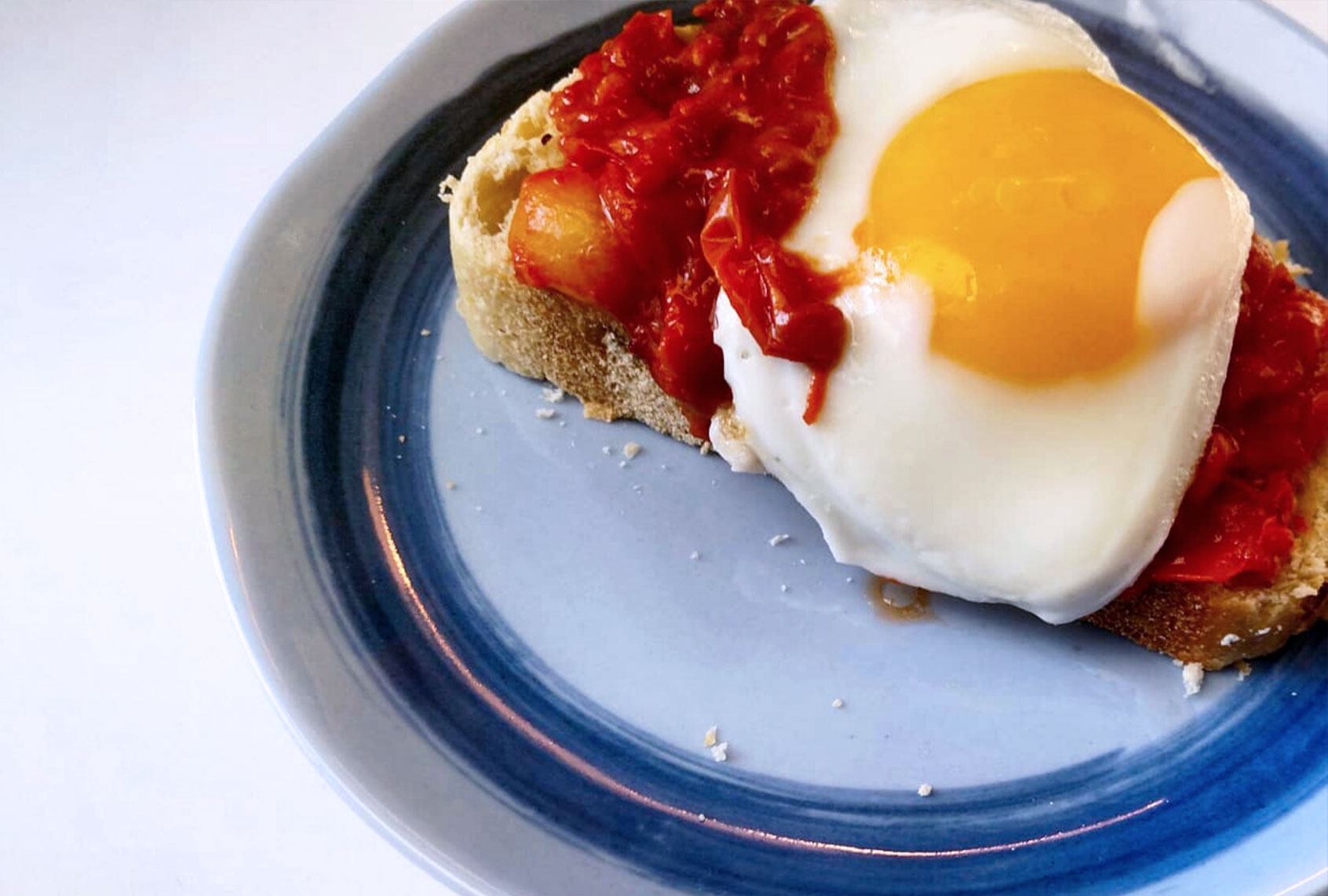
Which is kind of ironic because the dish uova in purgatorio, or eggs in purgatory, is one of those that comes together in under a half hour. Eggs in purgatory is an Italian play on shakshuka, where eggs are suspended in a spicy tomato sauce (much like souls are suspended in purgatory between death and heaven), which is sopped up with crusty toast.
Typically it's made in a large skillet and can serve six to eight people, so I decided to make a more compact version for one using fresh cherry tomatoes and a single fried egg. It's a versatile dish that satisfies any time of the day and while it's a little more effort than a one-skillet scramble, trust me — it's worth the wait.
* * *
Advertisement:
RECIPE: Egg in Purgatory on Toast Serves 1
½ cup of cherry tomatoes, roughly chopped
1 clove of garlic, minced
1 tablespoon of tomato paste
2 tablespoons of olive oil, divided
2 teaspoons of smoked paprika
3 teaspoons of red pepper flakes, plus more for garnish (optional)
1 egg
1 slice of toasted hearty bread; I love a roasted garlic or sourdough
Salt to taste
1. Pour one tablespoon of olive oil into a small saucepan over medium heat, then add the garlic. Cook until lightly browned, stirring occasionally, about five minutes.
2. Add the tomatoes, tomato paste, paprika, red pepper flakes and salt to taste. Stir until combined and slightly thickened, about three to five minutes. Set aside.
Advertisement:
3. In a small pan, add the remaining olive oil over medium heat and add the egg. Cover with a tight-fitting lid and cook for 3 minutes, or until white is set.
4. Time for assembly! Spread the toast with the spicy tomato mixture, then place the egg on top. Season with a little more salt and, if desired, more red pepper flakes.
The acreage devoted to tomatoes in Almería has been reduced again, thereby continuing the downward trend of recent years. The increase in production costs, the impact of pests and sales prices with tight margins have been the main reasons for Almeria's producers to switch to other products, like peppers and zucchini, whose production costs are much lower. Up until week 44, tomato prices, as well as those of other vegetables, with the exception of eggplant, have remained high. As of week 45, prices have started to fall, coinciding with the holiday of November 1 and the growth in the supply due to the higher temperatures.
"This year, the drop in the tomato production is becoming more noticeable, with around 20% less compared to last year, especially in the case of loose round tomatoes. Sales are smooth, as there is less pressure from the supply. In about two or three weeks, large volumes from Morocco will start to arrive on the market and there will be more competition,” says Francesc Llonch, manager of the Gavà Grup.
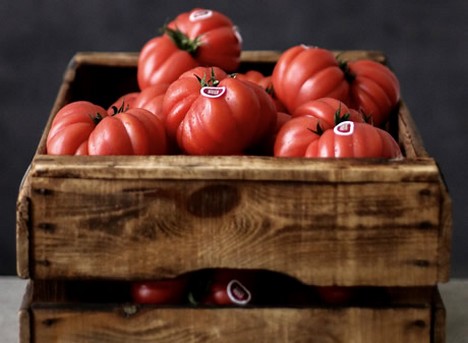
“So far, vine tomato prices have reached very high levels and tomato specialties have become around 30% more expensive than in the previous season. The exception is the round or ball tomato, which is cheaper. This tomato is highly produced in Morocco, and Spain has lost a lot of market share in Europe in recent years. Fortunately, despite growing competition, Morocco doesn't have consistent productions of plum, vine and other types of tomatoes, as well as other products, such as peppers and zucchini, so Spain still dominates," says Francesc Llonch.
According to the producer and marketer, although the zucchini and pepper productions have grown this year, prices have been higher compared to last season.
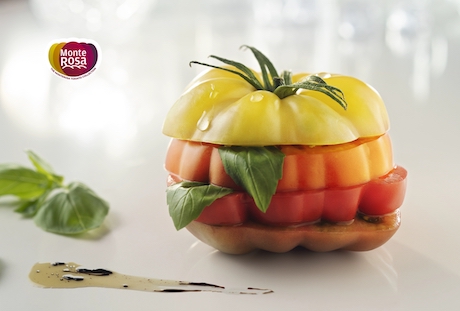
“This must be an effect of COVID-19. It is understandable in the case of tomatoes, as there is a smaller supply, but for the rest of vegetables, like cucumbers, there is no concrete explanation. Only eggplant has become cheaper. The first wave of the pandemic caught us at the end of the season. This second wave has come in the middle of the autumn / winter campaign and it will be very different. With this uncertainty, we have decided to slightly reduce the production of our Monterrosa tomato specialty, whose supply and demand have so far maintained a good balance.”
Tomato Sauce Market Research Report covers the present scenario and the growth prospects of Tomato Sauced Market for 2015-2026. The report covers the market landscape and its growth prospects over the coming years and discussion of the Leading Companies effective in this market. Tomato Sauce Market has been prepared based on an in-depth market analysis with inputs from industry experts. To calculate the market size, the report considers the revenue generated from the sales of Tomato Sauce globally
This report will help you take informed decisions, understand opportunities, plan effective business strategies, plan new projects, analyse drivers and restraints and give you a vision on the industry forecast. Further, Tomato Sauce market report also covers the marketing strategies followed by top Tomato Sauce players, distributor’s analysis, Tomato Sauce marketing channels, potential buyers and Tomato Sauce development history.
Along with Tomato Sauce Market research analysis, buyer also gets valuable information about global Tomato Sauce Production and its market share, Revenue, Price and Gross Margin, Supply, Consumption, Export, Import volume and values for following Regions:
North America
Europe
China
Japan
Middle East & Africa
India
South America
Others
In the Tomato Sauce Market research report, following points market opportunities, market risk and market overview are enclosed along with in-depth study of each point. Production of the Tomato Sauce is analyzed with respect to various regions, types and applications. The sales, revenue, and price analysis by types and applications of Tomato Sauce market key players is also covered.
Impact of COVID-19:
Tomato Sauce Market report analyses the impact of Coronavirus (COVID-19) on the Tomato Sauce industry.
Since the COVID-19 virus outbreak in December 2019, the disease has spread to almost 180+ countries around the globe with the World Health Organization declaring it a public health emergency. The global impacts of the coronavirus disease 2019 (COVID-19) are already starting to be felt, and will significantly affect the Tomato Sauce market in 2020.
The outbreak of COVID-19 has brought effects on many aspects, like flight cancellations; travel bans and quarantines; restaurants closed; all indoor events restricted; emergency declared in many countries; massive slowing of the supply chain; stock market unpredictability; falling business assurance, growing panic among the population, and uncertainty about future.
COVID-19 can affect the global economy in 3 main ways: by directly affecting production and demand, by creating supply chain and market disturbance, and by its financial impact on firms and financial markets.
FOR ALL YOUR RESEARCH NEEDS, REACH OUT TO US AT:
Address: 6400 Village Pkwy suite # 104, Dublin, CA 94568, USA
Contact Name: Rohan S.
Email:[email protected]
Phone: +1-909-329-2808
UK: +44 (203) 743 1898
November 09, 2020 at 07:12AM
https://ift.tt/36aQP7S
COVID-19 Update: Global Tomato Sauce Market is Expected to Grow at a Healthy CAGR with Top players: Symrise AG, Döhler GmbH, Kiril Mischeff, Riviana Foods Pty Ltd, Tiger Brands Limited, etc. | InForGrowth - TechnoWeekly
Certain dishes are just nostalgic. One bite and they immediately take you back to a specific place and time. Goulash is one of those dishes for me. A spoonful transports me back to my mom’s kitchen with blue formica countertops. I can almost feel my legs swinging under me as I belly up to the oak dining table stained with faded traces of paints and inks from various school and craft projects. Dad refinished the table at some point, but one end still bears the lightened spot where I spilled some nail polish remover when trying to get a price tag off of something one time.
You know, kitchen tables can tell us a lot about our families. The well-worn, imperfect ones have the most to share.
As the cooler weather comes, we turn to hearty, stick-to-your ribs soups and stews to fill our bellies and perhaps provide a little comfort. So, turning my mom’s traditional American goulash recipe into a hearty soup seemed like the perfect idea.
This tomato-based soup is filled with browned ground beef, whole-kernel corn, onions, garlic and tender elbow macaroni.
Add corn for a pop of sweetness. (Stacey Little/Southern Bite)
Add corn for a pop of sweetness. (Stacey Little/Southern Bite)
There is tons of tomato flavor in this dish because I use diced tomatoes, tomato sauce and tomato paste. And since it’s the primary flavor, I recommend you use the good stuff. Red Gold Tomatoes are steam-packed fresh to preserve the true tomato taste. They don’t have the “can” taste you can find in other canned tomatoes. So they are perfect for this dish.
Another thing that I just love about this recipe: It’s an easy and affordable way to feed a big family. I got 4 1/2 quarts out of this recipe, so it’s great if you’ve got lots of hungry mouths to feed.
And like so many tomato-based dishes, this recipe is even better the next day. So it’s perfect for leftovers and freezes pretty well, too. Just be aware that the pasta can get mushy when it’s been frozen, but the flavor is still amazing.
Mom always topped her goulash with shredded cheddar cheese, so that’s an important part of the flavor to me. That’s why I add it to this soup as well. But you can certainly leave it off if you’d like.
Corn has always been a part of Mom’s goulash, but I don’t often find it in other recipes. I love the little pop of sweetness it gives each bite. That said, you can use it, swap it for another favorite veggie or leave it out completely.
Serve with shredded cheddar cheese for more flavor. (Stacey Little/Southern Bite)
Regardless, I know you and your family are going to love this hearty, rich take on a classic. Y’all enjoy.
Goulash Soup
Prep time: 15 minutes
Cook time: 20 minutes
Serves: 12
Ingredients
2 pounds ground chuck
1 large onion, chopped
3 cloves garlic, minced
8 cups beef broth
1 (28-ounce) can petite diced tomatoes
1 (29-ounce) can tomato sauce
1 (6-ounce) can tomato paste
1 (15.25-ounce) can whole-kernel corn, drained
1 tablespoon Worcestershire sauce
1 tablespoon paprika
2 teaspoons salt
1/2 teaspoon black pepper
2 cups uncooked elbow macaroni
shredded cheddar cheese for topping (optional)
Instructions
In a large stock pot, cook the ground beef with the onions over medium heat until it is brown and cooked through. Drain the excess grease and return the ground beef and onions to the pot over the heat.
Add the garlic and cook, stirring constantly for 1 minute.
Add the beef broth and stir to combine.
Add the undrained tomatoes, tomato sauce, tomato paste and drained corn, and mix well.
Add the Worcestershire sauce, paprika, salt and pepper. Stir to combine.
Bring a boil. Add the macaroni and stir well. Reduce the heat to a simmer and cook uncovered for about 10 minutes or until the macaroni is tender to your liking. Add additional salt and pepper to taste, if desired.
Serve topped with shredded cheddar cheese, if desired.

 When thinking of 2020, cocktails may not be the first thing to come to your mind. Still it’s cocktail’o clock at the moment – cocktail tomatoes that is. Even though the European tomato prices in the traditional season have been unfavorable, the cocktail segment has been a positive exception. Is it an effect of the COVID outbreak and people paying more attention to their food? “Could be, but the cocktail segment has grown for many years now”, says Wilfred Scheffers with Plantfactory, in charge of the marketing and sales of TomaTech tomato varieties in Northern Europe.
 Whether it will be the Pina Colada, Jawbreaker or Screwdriver hasn’t been deciced, but the TT818 is another remarkable variety from the TomaTech portfolio. “Although we might better describe it as the Reserva wine under the tomatoes”, Wilfred laughs, referring to the aromatic, herby flavor of the tomato. But before you get to taste this one, it’s the color that attracts attention: when ripe, it’s a violet/purple variety. “A beautiful contrast since also the green parts are high in color and strong in quality. The growth is very consistent and the fruits are high in lycopene and strong against tearing. All in all it’s a beautiful, exclusive product.”






 Havecon Horticultural Projects




 Francesc Llonch


