Rechercher dans ce blog

Tuesday, March 30, 2021

Drivers Are Returning to the Road. That Is Good News for Corn Growers. - The Wall Street Journal

ersa.indah.link

Corn prices have hit their highest levels in almost eight years. Analysts say they are likely to get a further boost from motorists.

Drivers returning to the road are expected to lift demand for ethanol. About 40% of the U.S. corn crop goes to producing the gasoline additive, and consumption has plunged amid the pandemic. Now ethanol producers envision a rebound powered by economic reopenings and a potential wave of bioenergy-friendly regulations from the Biden administration.

Corn prices have already climbed about 50% over the past six months, lifted by increased demand from China. That country is buying more row crops in an attempt to bounce back from the African swine fever’s destruction of its hog herds and meet targets set in its recent trade agreement with the U.S. Chinese corn imports in the first two months of 2021 were more than five times higher than a year earlier, German bank Commerzbank AG said in a note last week.

On Feb. 9, corn topped $5.74 a bushel—its highest intraday level since July 2013. The most-active corn contract trading on the Chicago Board of Trade closed Monday at nearly $5.47 a bushel.

U.S. production of ethanol—found in roughly 98% of U.S. gasoline, according to the U.S. Energy Department—hasn’t returned to pre-pandemic levels. Domestic production stood at 922,000 barrels per day for the week ended March 19, the U.S. Energy Information Administration said Wednesday, down from more than a million barrels at this time in 2019.

The Link Lonk


March 30, 2021 at 04:30PM
https://ift.tt/3rGvsEw

Drivers Are Returning to the Road. That Is Good News for Corn Growers. - The Wall Street Journal

https://ift.tt/3gguREe
Corn

GRAINS-Soybeans falls for 4th session on U.S. planting prospects, corn flat - Successful Farming

ersa.indah.link

* Soybean drops on expectations of higher U.S. planting * Corn flat, wheat down after 2 days of gains (Recasts with details throughout, price update) By Naveen Thukral and Sybille de La Hamaide PARIS, March 30 (Reuters) - Chicago soybean futures slid for a fourth consecutive session, while corn stabilised after falling 1% the previous day as expectations of higher U.S. plantings this year weighed on the market. Wheat fell after closing higher for the last two sessions. "We are expecting a big planted area for corn and beans," Ole Houe, director of advisory services at brokerage IKON Commodities in Sydney, said. "But we think that there could be a few supportive surprises in the report, not so much on the planted area but more around stocks." The U.S. Department of Agriculture is scheduled to release its annual U.S. planting intentions and quarterly grain stocks reports on March 31. Analysts expect U.S. growers to increase their seedings of corn and soybeans this spring compared with last year, in response to strong export and domestic demand that lifted prices to multi-year highs in recent months. The most-active soybeans contract on the Chicago Board Of Trade (CBOT) lost 0.1% to $13.91-1/2 a bushel by 1100 GMT, having closed 1% lower in the previous session. Corn was virtually unchanged at $5.47 a bushel and wheat gave up 0.6% to $6.13 a bushel. Concerns that a resurgence in African swine fever outbreaks in China's huge hog herd will hit demand for soymeal, used in animal feed, in the coming months also pressured prices. Late March rains in Argentina have prepared the ground for smooth wheat and barley sowing, but the storms arrived too late to help corn and soy yields in areas suffering from months of dry weather, farmers and crop analysts said on Monday. The sowing of Brazil's second corn crop reached 98% of the estimated area for the Center-South of the country through last Thursday, a report by AgRural found. Despite a delay in plantings that caused many farmers to sow the cereal outside the ideal climate window, Brazil's second corn crop is developing well across the region, the consultancy said. Prices at 1100 GMT Last Change Pct End Ytd Move 2020 Pct Move CBOT wheat 613.00 -3.75 -0.61 640.50 -4.29 CBOT corn 547.00 0.25 0.05 484.00 13.02 CBOT soy 1391.50 -1.50 -0.11 1311.00 6.14 Paris wheat 211.50 0.75 0.36 213.25 -0.82 Paris maize 212.00 0.50 0.24 219.00 -3.20 Paris rapeseed 510.00 -3.25 -0.63 418.25 21.94 WTI crude oil 60.73 -0.83 -1.35 48.52 25.16 Euro/dlr 1.17 0.00 -0.26 1.2213 -3.95 Most active contracts - Wheat, corn and soy US cents/bushel, Paris futures in euros per tonne (Reporting by Naveen Thukral and Sybille de La Hamaide; Editing by Subhranshu Sahu and Barbara Lewis)

© Copyright Thomson Reuters 2021. Click For Restrictions - http://about.reuters.com/fulllegal.asp

The Link Lonk


March 30, 2021 at 06:30PM
https://ift.tt/31AuxdO

GRAINS-Soybeans falls for 4th session on U.S. planting prospects, corn flat - Successful Farming

https://ift.tt/3gguREe
Corn

Sure-Flex Hybrids promotes $97 per unit corn seed — 'royalty-free' - AG Week

ersa.indah.link

Mitch Rowe, 37, (rhymes with “now”) is CEO of Sure-Flex Hybrids LLC, a company he started in November 2017. The company is young but expects to sell conventional, off-patent corn genetics to 750 growers this year. Many customers are in the Deep South states — Carolinas, Alabama and Mississippi — but also the Northeast as well as North Dakota, Minnesota, Wisconsin and Michigan.

Mitch Rowe, 37, of Jackson, Minn., is chief executive officer of Sure-Flex Hybrids, LLC, a company that has used off-patent corn inbred lines to produce hybrids that are sold, royalty-free. Photo taken March 5, 2021, Jackson, Minn. Mikkel Pates / Agweek

Mitch Rowe, 37, of Jackson, Minn., is chief executive officer of Sure-Flex Hybrids, LLC, a company that has used off-patent corn inbred lines to produce hybrids that are sold, royalty-free. Photo taken March 5, 2021, Jackson, Minn. Mikkel Pates / Agweek

The company operates out of an old seed production facility built in the 1940s by DeKalb Seed Co. at Jackson, Minn.

In 2015, Mitch Rowe, and his brother, Nick, formed Rowe Enterprises in 2015. The two bought former DeKalb buildings that include Nick’s ag engineering company, and Mitch’s SureFlex Hybrids Photo taken March 5, 2021, Jackson, Minn. Mikkel Pates / Agweek

In 2015, Mitch Rowe, and his brother, Nick, formed Rowe Enterprises in 2015. The two bought former DeKalb buildings that include Nick’s ag engineering company, and Mitch’s SureFlex Hybrids Photo taken March 5, 2021, Jackson, Minn. Mikkel Pates / Agweek

Steeped in ag

Newsletter signup for email alerts

Rowe grew up on a diversified farm where his family raised corn and soybeans and operated an artificial insemination boar stud business, seven miles south of Jackson. He started college at Minnesota West in Worthington, Minn., where met his wife, Laura. He went on to receive a bachelor’s degree in crop and soil science from the University of Wisconsin-River Falls in 2006. They married that year and today have five children age 13 and younger.

Mitch started his agriculture career as a sales agronomist with a local cooperative, and then worked five years as a production agronomist from Pioneer Hybrids soybean production facility in Jackson. He started his own franchise seed distributorship in 2011.

“I just got tired of making these genetic and trait suppliers a whole bunch of money,” Mitch said. “I figured there had to be another way to offer a product to the farmer and not have the rules and regulations that these trait and genetic suppliers put on us.”

In its third year marketing corn hybrids made from off-patent inbred lines, Sure-Flex Hybrids LLC, of Jackson, Minn., expects to sell to 750 growers in the country in 2021. Photo taken March 5, 2021, Jackson, Minn. Mikkel Pates / Agweek

In its third year marketing corn hybrids made from off-patent inbred lines, Sure-Flex Hybrids LLC, of Jackson, Minn., expects to sell to 750 growers in the country in 2021. Photo taken March 5, 2021, Jackson, Minn. Mikkel Pates / Agweek

In 2015, Mitch and his brother, Nick Rowe, formed Rowe Enterprises, which remodeled the headquarters for the old DeKalb location. Nick separately started ProAg Engineering, which does livestock feedlots and does concrete and dirt work for them.

Mitch called it Sure-Flex.

The “Sure-Flex” name is taken from the historic “Lancaster Sure Crop” corn variety, developed in the early 1900’s in Lancaster County, Pa., and the “flex” ear type, meaning it ears will get larger under a smaller population. Photo taken March 5, 2021, Jackson, Minn. Mikkel Pates / Agweek

The “Sure-Flex” name is taken from the historic “Lancaster Sure Crop” corn variety, developed in the early 1900’s in Lancaster County, Pa., and the “flex” ear type, meaning it ears will get larger under a smaller population. Photo taken March 5, 2021, Jackson, Minn. Mikkel Pates / Agweek

The “Sure” is a nod the famous “Lancaster Sure Crop” corn variety, a yellow field dent corn developed in the early 1900s by Isaac Hershey of Lancaster County, Pa. (no connection to Hershey candy company, also founded in the county). Most modern corns can trace their roots to Lancaster Sure Crop. The “Flex” comes from the “flex” ear type, meaning its ears will get larger under a smaller population.

Mitch financed the company through his own resources and loans, until seed sales came around.

Genetic initiative

In November 2017 he obtained “independent germplasm,” by ordering it from the U.S. patent office in Washington, D.C. The government protects plant patents for 20 years. Mitch doesn’t know exactly where they keep the seed, but the patent office sent packages of 50 kernels for $200 each. Sure-Flex started with eight inbred line packages. (One problem is the 200 kernels are 20 years old, and not all will grow,” he said. In some of the packages, no seeds grew at all.)

Sure-Flex Hybrids lines were acquired from the U.S. Patent Office, in Washington, D.C. Submitted photo taken in 2020, Jackson, Minn. Sure-Flex Hybrids / Agweek

Sure-Flex Hybrids lines were acquired from the U.S. Patent Office, in Washington, D.C. Submitted photo taken in 2020, Jackson, Minn. Sure-Flex Hybrids / Agweek

Mitch enjoys describing the traditional corn breeding.

“You have a male and a female and you need to get it to a large state to have commercial release of a product,” he said. “You’ve got to go out and de-tassel. It’s intensive and takes a lot of manpower to go through and pull tassels. We run a one-four pattern — one row of males and four of rows female and then one row of male, again.”

Sure-Flex Hybrids plants five to six “spins” of seed per year, sometimes using winter nurseries, Florida and Arizona, as well as 500 acresin Minnesota on the Rowes produce seed corn on their own farm. Submitted photo taken in 2020, Jackson, Minn. Sure-Flex Hybrids / Agweek

Sure-Flex Hybrids plants five to six “spins” of seed per year, sometimes using winter nurseries, Florida and Arizona, as well as 500 acresin Minnesota on the Rowes produce seed corn on their own farm. Submitted photo taken in 2020, Jackson, Minn. Sure-Flex Hybrids / Agweek

The Rowes use machines to remove about 85% of the tassels. The first kind of machine is like a small lawn mower with two blades that cuts the tassel off. The second kind is a “puller” with two bicycle tires that pulls the tassels as they go through.

Finally, they subcontract with SMAK Detasseling Inc. 100 miles away at Le Mars, Iowa. SMAK brings a busload of 30 to 40 high school kids to “go in on foot and clean the rest.” (The kids get $8 to $12 an hour.)

Sure-Flex plants the lines in multiple locations, to get multiple generations, or “spins,” as they’re called in the business. They have used winter nurseries, with some in Florida and Arizona, along with Minnesota. The Rowes produce seed corn on 500 acres and another 200 acres of commercial soybeans around Jackson.

They can complete five or six “spins” in a year.

So far, the Sure-Flex Hybrids LLC company at Jackson, Minn., has most of its people in the backshop area, while only Mitch Rowe and one other sales person offer customer support. Seed ordering is entirely through e-commerce. Photo taken March 5, 2021, Jackson, Minn. Mikkel Pates / Agweek

So far, the Sure-Flex Hybrids LLC company at Jackson, Minn., has most of its people in the backshop area, while only Mitch Rowe and one other sales person offer customer support. Seed ordering is entirely through e-commerce. Photo taken March 5, 2021, Jackson, Minn. Mikkel Pates / Agweek

The 2019 season was the first season where they had something to sell — nine hybrids. Most went to the northern clients in North Dakota, Minnesota and Wisconsin.

Out of the first product lineup, they were mostly 85- to 103-day hybrids. They had only one product at 115 days, which would go to the Deep South. A half-dozen are dual-purpose varieties, good for silage.

Sure-Flex Hybrids of Jackson, Minn., does seed increases in a “one-four” pattern -- one row of males and four of rows female and then one row of male, again. Tassels are removed by machine and by a crew of high schoolers from Le Mars, Iowa. Submitted photo taken in fall 2020, Jackson, Minn. Sure-Flex Hybrids / Agweek

Sure-Flex Hybrids of Jackson, Minn., does seed increases in a “one-four” pattern -- one row of males and four of rows female and then one row of male, again. Tassels are removed by machine and by a crew of high schoolers from Le Mars, Iowa. Submitted photo taken in fall 2020, Jackson, Minn. Sure-Flex Hybrids / Agweek

Sure-Flex has continued to acquire inbred lines and now has 74 in its system. “Whenever something comes off-patent, we’re grabbing it,” he said. They sold nine hybrids in 2019, 27 hybrids in 2020, and are up to 34 hybrids in 2021.

Today, the company’s product line goes from 78-day to 117-day maturity hybrids. The means they have maturity fit for “most of the (corn) acres in the United States.”

“We continue to make more products every year,” he said. “We’re sitting here operating royalty-free.”

The Sure-Flex Hybrids LLC facilities at Jackson, Minn., are housed in the former DeKalb seed plant that operated from the 1940s to the 1980s. Photo taken March 5, 2021, Jackson, Minn. Mikkel Pates / Agweek

The Sure-Flex Hybrids LLC facilities at Jackson, Minn., are housed in the former DeKalb seed plant that operated from the 1940s to the 1980s. Photo taken March 5, 2021, Jackson, Minn. Mikkel Pates / Agweek

$97, ‘direct’

In 2020, Mitch and company decided the best marketing strategy was to “go direct to the farm,” and to avoid “dealers, and anybody else who touches that bag of seed before it gets to the farm.” They sold to 400 customers in 2020 — double what they sold in 2019.

The sales force is Mitch and one other salesman, Tim Thurmer, also from Jackson. The company has 68% grower retention, a figure he expects will improve. The age and size of clients is “all over the board.”

Sure-Flex produces 80,000-kernel bags (about 50 pounds) and 40- to 50-unit bulk bags (roughly 2,200 pounds). They offer standard insecticide and fungicide treatments, but not microbials.

They employ an “e-commerce” mode, where customers order online at a flat price. “That’s $97 direct to the farm,” Mitch said. “That means shipping, all that stuff is included. The only thing the farmer pays is $97.”

“We’re loud and proud about our price,” he said. “It’s $97, and that’s throughout the whole growing season."

He said there are no discount levels for volume or timing. “I would argue we’re one of the few that publishes a price from start-to-finish, and everybody knows where we’re at.”

March is their hottest sales month.

The lack of early-selling discounts means that farmers delay seed purchases two or three months later than for most other companies. “We keep a price, hold it through the growing season, and don’t penalize the guys that don’t want to spend their cash later in the growing season.”

“We’d like to get to where everybody is able to ‘click-and-buy,’” he said. “But we understand that’s pretty unique and there’s going to be a lot of questions.” The company has a toll-free line, 833-300-9797.

Most every customer for the first time calls the 800 number first, and Mitch or a colleague leads them to the website.

There is no minimum shipping amount. They have a couple of 2,000-bag customers, seeding about 5,000 acres.

If customers need to replant corn, Sure-Flex sells it to them at 50% off the retail price ($48.50). GMO varieties are developed for things like drought resistance and corn borers. Mitch said that if it is dry and corn borers come, “They need to spray that to control that issue,” he said. And there is crop insurance.

Deep South appeal

Sure-Flex produces 80,000-kernel bags (about 50 pounds) and 40- to 50-unit bulk bags (roughly 2,200 pounds). Photo taken March 5, 2021, Jackson, Minn. Mikkel Pates / Agweek

Sure-Flex produces 80,000-kernel bags (about 50 pounds) and 40- to 50-unit bulk bags (roughly 2,200 pounds). Photo taken March 5, 2021, Jackson, Minn. Mikkel Pates / Agweek

The customer submits the order online. They can pay with a credit card, at no extra fee. Sure-Flex uses LTL (less-than-truckload) shipping, direct to the farm gate. They use XPO Logistics, an international trucking and freight company to get the product to the customer, usually within three to four days.

“In 2020, we shipped out to 38 states,” he said. “We have the capacity for 2022 sales season, to produce 500,000 units of seed corn,” he said. That would plant about 1.4 million acres. Right now Sure-Flex orders are averaging 23 to 25 bags per customer. That seeds 60 to 100 acres.

“We have guys planting 10,000 seeds per acre, so they can get 8 acres a bag,” he said.” Then we have guys with 35,000 seeds per acre, so they get 2.3 acres per bag.”

“Obviously this is new,” he said. “We can’t publish a whole bunch of yield data because it never existed before at the level we can make guys feel comfortable. It’s a process where people have tried us on acres and they come back and buy a little bit more every year.”

“One thing we don’t do here is a lot of plot data,” he said. “It’s not because we’re afraid of our product not making guys more money. What I end up finding out when you ask these farmers, they never really believe self-published plot data anyway. What seed company is going to show them(selves) losing? Our approach is, you’ve got to try it for yourself.

“Is the $97 too good to be true? Some cases, they’ll say, ‘Hey, there’s no way you can compete.’ Well give us a try, and we’ll make you a believer once you see it’s competitive and it’s going to make you more money.”

Established genetics companies hold a lot of the genetic cards today. Some dealers are selling non-GMO corn through their pipelines at cheaper prices, but not $97 per bag.

Genetic cards

Sure-Flex stays out of head-to-head competition.

“We’re not plot-winners,” Mitch said. “We can give up a few bushels (in yield) and make guys more money at the price we’re at. That’s our marketing stance — we’re here to make you more money.”

According to one study, historical improvements in corn yield suggest a one- to two-bushel per year increase in corn yields, on average, suggesting 20-year old varieties would have a 20- to 40-bushel per acre yield drag.

Mitch said he and his customers are leery of “so-called’ independent test plots, he said.

He said it is “expensive,” to test, and drives up up the cost to our customer, although farmers historically seek plot data in making hybrid/variety selections. Similarly, he is skeptical of university plots, which are promoted as having no hidden agenda other than testing variety performance.

“I don’t know if they truly are independent,” Mitch said, offering no proof. As he talks to an agricultural magazine reporter, he adds: “I even will argue, I don’t know if agricultural media are independent, with the amount of money these guys are pumping into this stuff.”

The Un-’Conventional’

Sure-Flex deliberately sticks to “conventional” corn — stuff that doesn’t include a genetic modification (GMO), which is a separate kind of patent.

Mitch acknowledges growing non-GMO corn is “hard.”

“I’ll bet 50% of the calls are people asking if we have Roundup (ready) corn. We don’t,” he said. “That takes a segment of the marketplace out of our reach.”

His logic: “In areas where their yields are not 250-bushel (per acre) corn, they don’t need to be spending $300 a bag corn (seed) to get 180 bushel corn (yields),” he said. “That’s where we’ve shined, as a price-effective product.”

He notes farmers can plant Sure-Flex Hybrids almost as cheaply as they could plant soybeans in terms of seed cost per acre.

Some corn improvements — breeding that prevents green snap, for example — do not involve the GMOs for weed control.

“Our take on the industry is that they’ve been so focused much on getting everything to work with genetically modified traits, our argument is we don’t know there’s been a lot of success in just pure natural breeding.”

“I would argue that we’re going back to the way business was done before ‘traits’ came in, of actually having a true source of corn that is not owned by Bayer-Monsanto or Dow-Dupont.”

Mitch said competitors already malign “Sure-Flex” as “cheap corn.”

“The loudest people in social media and putting in negative comments are seed dealers themselves," he said. “We always get a kick out of that.”

There’s 30 million to 35 million bags sold in the United States every year.

“There’s room for everybody," he said. “I would say our biggest factor of why we’ve been successful is the growers want us to win, too. ... I think they treat us a little differently than everybody else.”

The Link Lonk


March 30, 2021 at 05:41PM
https://ift.tt/3wmptbs

Sure-Flex Hybrids promotes $97 per unit corn seed — 'royalty-free' - AG Week

https://ift.tt/3gguREe
Corn

Drought areas shrink in many top corn-growing states - Successful Farming

ersa.indah.link

The drought monitor released March 23 showed reduced drought in some of the top corn growing states as spring fieldwork gets underway. Drought continues to be particularly problematic in North Dakota, Colorado, and Texas.

Drought areas shrunk slightly in the No. 1 corn growing state. However, about 2% of Iowa is still suffering from extreme drought. Southeastern counties reported no moisture stress as of March 23.

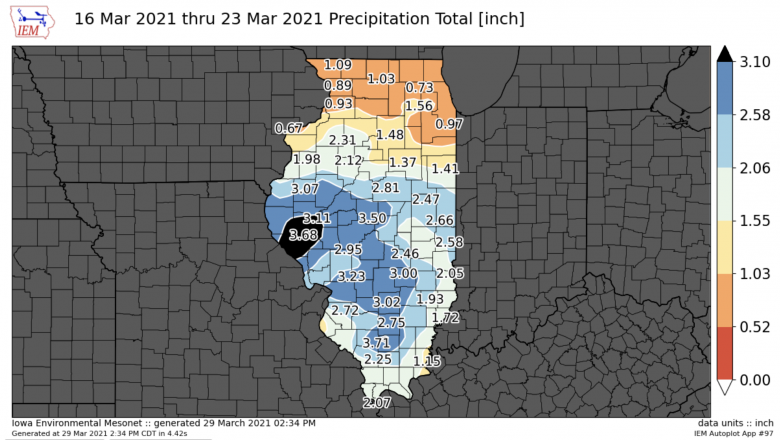
Across the Mississippi River to the east, in Illinois, drought areas also shrunk. The moderate drought conditions in the center of the state from the week prior were relieved thanks to more than an inch of precipitation. At the same time, abnormally dry conditions in the northeast corner of the state spread slightly.

Map of precipitation in Illinois

Photo credit: Iowa Environmental Mesonet

Severe drought in Nebraska shrunk by 2% since the previous drought monitor report, but still consumes 7% of the state, primarily in the southwest corner. In total, 66% of the Cornhusker state is facing some sort of moisture stress.

March 23 marked the second week of little change in Minnesota. About 1% of the state, the extreme southwest and northwestern counties, face severe drought. The entire state is abnormally dry or worse.

Moderate drought conditions grew in northern Indiana to cover about 14% of the state. The southern half of the Hoosier state reported no dryness as of March 23.

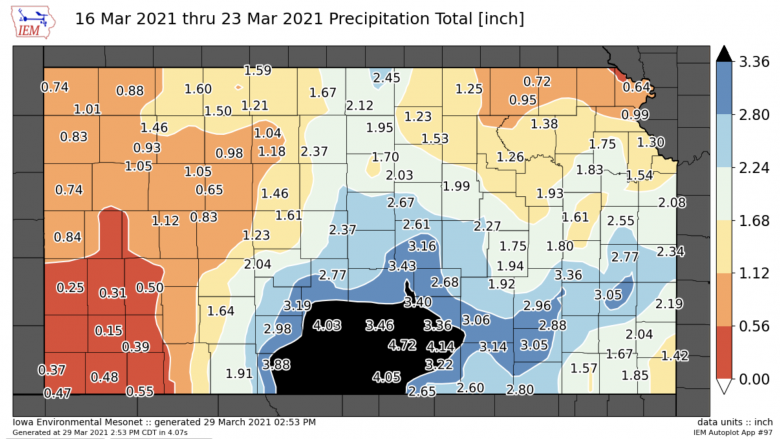
All extreme drought was eliminated from the most recent Kansas drought monitor map. Severe drought areas shrunk significantly and are now isolated to parts of two northwestern counties and three southwestern counties. Many Kansas counties reported an inch of rain or more between March 16 and 23.

Map of Kansas precipitation

Photo credit: Iowa Environmental Mesonet

South Dakota missed the precipitation that brought relief to many other corn growing states. The entire state is still suffering from abnormally dry conditions, or worse. About 40% of South Dakota is in severe drought as farmers there prepare for planting season.

In Ohio, moderate drought in the northeast part of the state grew. However, overall, drought stress in the state shrank by about 10%. The southern half of the state continues to have sufficient moisture.

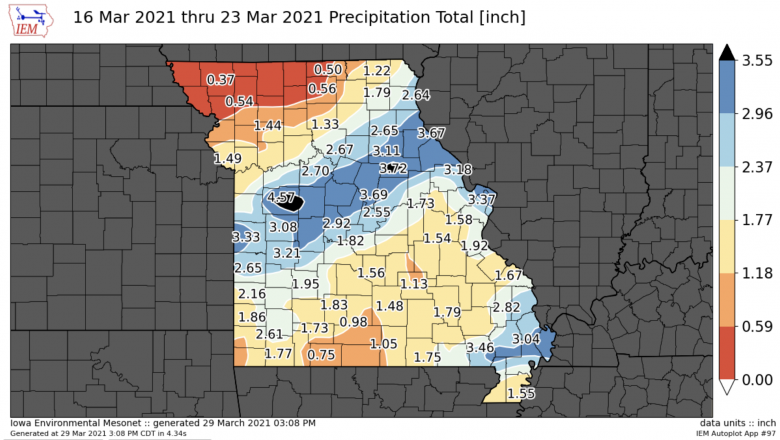
For the first time this spring, Missouri reported no drought conditions. In fact, some parts of the state recorded more than 3 inches of rain between March 16 and 23.

Map of Missouri precipitation

Photo credit: Iowa Environmental Mesonet

Abnormally dry conditions grew across Wisconsin, covering 99% of the state. Only a small portion of Grant county is free from moisture stress.

Across the Great Lakes in Michigan, moderate drought conditions jumped farther north, now consuming 18% of the state. About 79% of the state is abnormally dry.

For the fourth straight week, Kentucky reported no drought conditions.

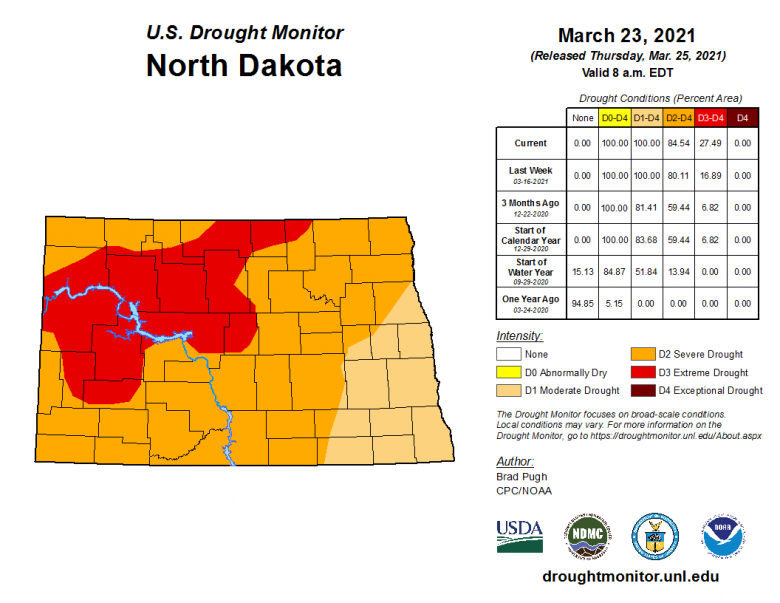
Extreme drought spread to cover 27% of North Dakota. The entire state is suffering from moderate drought, or worse this spring.

Map of North Dakota drought conditions

Photo credit: U.S. Drought Monitor

Drought also grew more severe in parts of Texas. About 7% is suffering from exceptional drought. Less than 10% of the Lone Star state reported no drought conditions.

There was little change in Tennessee’s drought conditions since the last report. The abnormally dry areas are still isolated to two spots covering less than 4% of the state.

Pennsylvania’s abnormally dry conditions in the northwest corner of the state expanded slightly to cover about 15% of the state.

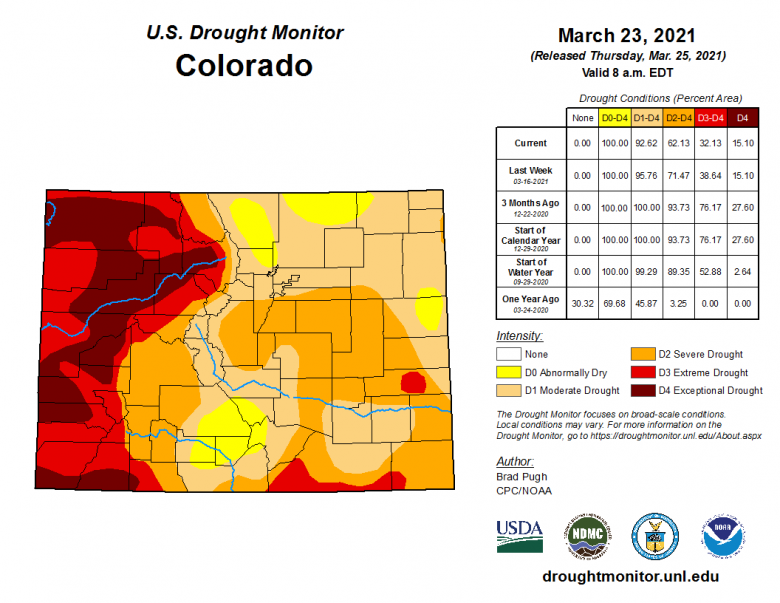
A band of precipitation cutting through the center of the state from north to south reduced the severity of some drought conditions in Colorado, but the entire state continues to struggle with moisture stress. Exceptional drought still covers 15% of the state.

Map of Colorado drought conditions

Photo credit: U.S. Drought Monitor

The Link Lonk


March 30, 2021 at 03:47AM
https://ift.tt/2Pj6mOH

Drought areas shrink in many top corn-growing states - Successful Farming

https://ift.tt/3gguREe
Corn

HUMOR: Grapes of laughs — let mandate wither on the vine - GoDanRiver.com

ersa.indah.link
Scott Hollifield

Scott Hollifield

Lawmakers in the great state of North Carolina are taking up the divisive issue of mandated grape juice in schools.

We’ll see what I can squeeze out of this ridiculous situation.

According to a story from the News & Observer of Raleigh, the source I turn to for reports about education and fruit from deciduous woody vines, House Bill 136 would make state, local and charter school boards ensure that 100% muscadine grape juice is available to students in every school.

It also calls for muscadine grape juice in community colleges' campus vending machines, the paper reported.

The bill’s sponsor said lawmakers need to mandate muscadine grape juice in all public schools “to help our growers, particularly our growers in the eastern part of the state."

According to the N.C. Cooperative Extension Office at N.C. State University, muscadine grapes are popular for wine, pie and jelly, all favorites of young students from the mountains to the coast.

At first, I hesitated to even address this subject. History tells us wading into the murky waters of school lunches is not without its risks.

Back in the ‘80s, former President Ronald Reagan squared off against critics who accused his administration of classifying ketchup as a vegetable.

Later, former First Lady Michelle Obama was chided by her opponents for pushing for healthier school meals.

And, in third grade, I was rebuked for stuffing green beans into a milk carton to make it appear as if I had cleaned my plate so I could score an extra chocolate oatmeal cookie. It was a sad end to my budding political career, derailing any future run for student council.

Supporters of the HB 136 noted that while it would require schools to offer muscadine grape juice, it would not mandate that students drink it. Cafeteria workers therefore would not be allowed to jam a funnel in Ethan’s mouth to force him to drink his daily mandated amount of sweet, sweet North Carolina muscadine grape juice.

“Mom, I don’t want to go to school today. My stomach hurts and my lips are still red.”

Reading the story and diving deeper into the bill, I came up with a list of pros and cons for state-mandated school muscadine grape juice.

  • Muscadine grape juice tastes pretty good. Not Mountain Dew good, but pretty good.
  • It would indeed help muscadine grape growers. In fact, if we mandate this North Carolina agricultural product for campus vending machines, we could theoretically pack them with the state’s other top agricultural products to help our farmers: Pork, sweet potatoes, tobacco, poultry, etc.

“What did you get out of the machine for a snack before fourth period, Ethan?”

“I got a sausage biscuit, a pack of Pall Malls and a boiled egg.”

  • Students would likely learn how to take muscadine grape juice, bag it up, store it in school toilet tanks to ferment and produce pruno, or prison wine. Then we’ve got drunken fourth-graders on the yard squaring off to settle beefs and such.

“I run things on this playground, Ethan, not you! Back off or I will shiv you with a No. 2 pencil.”

  • Loss of local control. One lawmaker who opposed the mandate, from the same party of the bill’s sponsor, said it's a great idea to have juice in schools, but "not to force it," according to the News & Observer.

Personally, I agree with that view. If local school boards, which answer to local voters, want to offer muscadine grape juice in schools, especially in communities were those grapes are grown, well, grab a jug and fill up Ethan’s cup.

But let’s not make everyone else drink the muscadine-flavored Kool-Aid.

Epilogue: The bill passed the state House 91-22 on second reading, and on a voice vote for third reading. It heads to the Senate.

Hollifield is editor of The McDowell News in Marion, North Carolina, and a humor columnist. Contact him at rhollifield@mcdowellnews.com.

The Link Lonk


March 30, 2021 at 11:00AM
https://ift.tt/3sBjUDE

HUMOR: Grapes of laughs — let mandate wither on the vine - GoDanRiver.com

https://ift.tt/3eO3jWb
Grape

Monday, March 29, 2021

GRAINS-Corn falls 1%, soy drifts lower on U.S. plantings outlook - Successful Farming

ersa.indah.link

(Updates with closing U.S. prices)

By Julie Ingwersen

CHICAGO, March 29 (Reuters) - U.S. corn futures fell about 1% on Monday on position squaring ahead of crop reports due this week from the U.S. Department of Agriculture (USDA) along with forecasts for generally favorable planting weather in the Midwest, analysts said.

Soybean futures also declined while wheat closed higher, rallying on bargain buying after the benchmark Chicago Board of Trade May wheat contract fell to its lowest level of 2021.

A firmer dollar hung over the markets, in theory making U.S. grains less competitive globally.

CBOT May corn settled down 5-3/4 cents at $5.46-3/4 per bushel. CBOT May soybeans ended down 7-1/2 cents at $13.93 a bushel after dipping to $13.83, the contract's lowest level since March 2.

CBOT May wheat finished up 3-1/2 cents at $6.16-3/4 a bushel, bouncing after a drop to $6.07-1/4, its lowest since Dec. 22.

Corn and soybean futures were pressured by outlooks for mostly warm and dry conditions in the Midwest as farmers begin spring field work.

"CBOT corn and soybean futures traded lower on forecasts for above-normal temperatures across the Corn Belt during (first-half) April, which could contribute to a timely start to U.S. corn and soybean planting," Dan Cekander, president of DC Analysis, wrote in a client note.

Analysts expect U.S. growers to increase their seedings of both crops this spring compared to a year ago, in response to strong export and domestic demand that lifted prices to multi-year highs in recent months.

The USDA is scheduled to release its annual U.S. planting intentions and quarterly grain stocks reports on March 31.

Commodity funds hold sizable net long positions in CBOT corn and soybean futures, leaving both markets prone to long liquidation ahead of the two crop reports, which have a history of making waves in the futures market.

"Traders are rather cautious ahead of (the USDA report) publication," French analyst Agritel said in a note.

(Additional reporting by Colin Packham in Canberra and Sybille de La Hamaide in Paris; editing by Simon Cameron-Moore and Susan Fenton)

© Copyright Thomson Reuters 2021. Click For Restrictions - http://about.reuters.com/fulllegal.asp

The Link Lonk


March 30, 2021 at 04:33AM
https://ift.tt/31vnCCR

GRAINS-Corn falls 1%, soy drifts lower on U.S. plantings outlook - Successful Farming

https://ift.tt/3gguREe
Corn

March Rains to Help Argentine Wheat/Barley Sowing, But Too Late to Restore Soy/Corn Yields - Agweb Powered by Farm Journal

ersa.indah.link
[unable to retrieve full-text content]March Rains to Help Argentine Wheat/Barley Sowing, But Too Late to Restore Soy/Corn Yields  Agweb Powered by Farm Journal The Link Lonk


March 30, 2021 at 01:56AM
https://ift.tt/3m4TGGZ

March Rains to Help Argentine Wheat/Barley Sowing, But Too Late to Restore Soy/Corn Yields - Agweb Powered by Farm Journal

https://ift.tt/3gguREe
Corn
Featured Post

Dry conditions decrease Brazilian corn production estimate - World Grain

ersa.indah.link BRASILIA, BRAZIL — Delayed planting and continued dry conditions has dropped Brazil’s estimated corn production 11 million...

Popular Posts