Rechercher dans ce blog

Monday, February 1, 2021

UA produces new white and pink grapes for wine, Indulgence and Dazzle - Magnoliareporter

ersa.indah.link

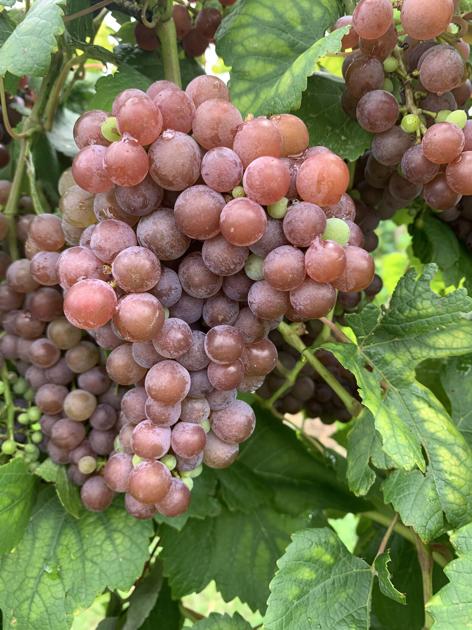
Two new wine grapes from the University of Arkansas System Division of Agriculture offer novel commercial options that are adapted for growing in Arkansas vineyards.

Indulgence is a white wine grape that produces wines with a muscat flavor, said John Clark, Distinguished Professor of horticulture and fruit breeding for the Arkansas Agricultural Experiment Station, the research arm of the Division of Agriculture.

Renee Threlfall, research scientist in the division’s department of food science, said Indulgence produces wine with floral, fruity and herbal aromas.

Dazzle is a pink grape that produces a white Gerwürztraminer-type wine, Clark said. Threlfall added that it has a spicy aroma in addition to the floral, fruity and herbal aromas.

Indulgence and Dazzle expand options for commercial production in Arkansas and other areas with similar growing conditions. Threlfall said both grapes can produce single-varietal wines or can be blended with other wines to enhance their flavors or aromas.

Indulgence and Dazzle follow the rich, red Enchantment and the neutral white Opportunity, the first two wine grapes from the Division of Agriculture’s fruit breeding program.

Clark said the original crosses to produce these grapes were made by the late James N. Moore, who founded the Arkansas fruit breeding program in 1964.

“Many Mid-South, Midwest, eastern U.S. and Arkansas wineries are using French-American hybrids, or wine grapes developed in New York that are not ideal for Arkansas,” Clark said. “Dr. Moore’s aim was to develop good quality grapes with substantial flavor that could grow in Arkansas’ environmental conditions.

“Developing a wine grape just takes a long time,” Clark said. “It requires years of input from industry to develop and advance breeding lines toward a grape that meets their needs.” Clark added that you have to make and test wines to make sure they’re not only desirable to consumers, but stable and consistent in storage, handling and serving.

Moore worked with the late Justin Morris, a division food scientist who specialized in viticulture and worked on vineyard management and winemaking for Arkansas. Their partnership lasted many years and continues today in the hands of Clark and Threlfall, who began their careers in Arkansas under Moore’s and Morris’ mentorship.

“These wine grapes are truly heritage projects,” Clark said.

At harvest, Indulgence averages 37 pounds per vine. Its muscat flavor is strong in the juice at crush, Threlfall said, and it was consistent in all years. Juice yield is one gallon for 13 pounds of fruit.

“For wine production, Indulgence needed sugar additions most years and acid additions some years,” Threlfall said. “Ethanol levels of wines were 10-12 percent.”

CLICK HERE for technical information on Indulgence’s fruit and wine compounds and titratable acidity.

Dazzle makes about a gallon of juice from 14 pounds of fruit, Threlfall said, and averaged about 22 pounds of fruit per vine.

“Flavor is light, semi-fruity, reflective of its Gerwürztraminer parent, and was consistent in all years,” Threlfall said.

“For wine production, Dazzle usually did not need sugar or acid additives,” she said. “Ethanol levels of wines were 10 to 12 percent.”

CLICK HERE for technical information on Dazzle’s fruit and wine compounds and titratable acidity.

“Soon, wine enthusiasts can purchase bottles of Indulgence and Dazzle wines, not only to enjoy the unique aromas and flavors, but also for the experience of drinking these wines made from grapes developed in Arkansas,” Threlfall said. “Imagine drinking a wine that was made in Arkansas, with grapes grown in Arkansas, and that the grapes for the wine were bred in Arkansas.”

The average harvesting date for Dazzle is August 15, Clark said. Indulgence ripens about August 14. Both grapes have endured winter temperatures down to 1 degree Fahrenheit without damage to canes or buds, he said.

Powdery mildew was seen on Indulgence in four out of 26 years of observation for disease and in two out of 22 years on Dazzle, Clark said. Downy mildew was not observed in either grape, even in heavy years for the disease. Black rot and anthracnose also were not observed. Fungicides were used in research vineyards and these varieties will need disease control similar to most bunch grapes.

Dazzle and Indulgence are available for license to propagators. Interested parties should contact Cheryl Nimmo at 479-575-3953 or by email at cnimmo@uark.edu for license availability.

CLICK HERE to read more continuing education news on our website. Tell your friends and family that thanks to our advertisers, they can read news for free on our website. Email us at news@magnoliareporter.com

CLICK HERE to find us on Facebook.

The Link Lonk


February 01, 2021 at 02:00PM
https://ift.tt/3oD8TPe

UA produces new white and pink grapes for wine, Indulgence and Dazzle - Magnoliareporter

https://ift.tt/3eO3jWb
Grape

MORNING BUSINESS REPORT: Hedge fund loses, Valentine's Day shopping, Grape Nuts - WFSB

ersa.indah.link

Keep it Clean. Please avoid obscene, vulgar, lewd, racist or sexually-oriented language.
PLEASE TURN OFF YOUR CAPS LOCK.
Don't Threaten. Threats of harming another person will not be tolerated.
Be Truthful. Don't knowingly lie about anyone or anything.
Be Nice. No racism, sexism or any sort of -ism that is degrading to another person.
Be Proactive. Use the 'Report' link on each comment to let us know of abusive posts.
Share with Us. We'd love to hear eyewitness accounts, the history behind an article.

The Link Lonk


February 01, 2021 at 06:56PM
https://ift.tt/3tg93zL

MORNING BUSINESS REPORT: Hedge fund loses, Valentine's Day shopping, Grape Nuts - WFSB

https://ift.tt/3eO3jWb
Grape

GRAINS-Corn rises to highest level since June 2013 on Chinese demand - Successful Farming

ersa.indah.link

* Corn jumps 1% on Chinese demand

* Soybeans firm as rains soak Brazil

* Wheat firms as global supplies tighten

By Colin Packham

CANBERRA, Feb 1 (Reuters) - U.S. corn futures rose more than 1% to hit a six-year high on Monday, driven up by strong Chinese demand.

Soybeans also gained drawing support from concerns over adverse weather in South America, while wheat also rose.

The most active corn futures on the Chicago Board Of Trade Cv1 were up 1.4% at $5.54-1/2 a bushel by 0257 GMT, near the session high of $5.55-3/4 a bushel, the highest since June 2013. Corn gained 2.3% in the previous session.

Analysts said corn is continuing to draw strong support from Chinese demand, the latest sign of which came last week when the U.S. Department of Agriculture confirmed private sales of 2.108 million tonnes of U.S. corn to China.

"That sale means China will likely have lifted 6 million tonnes of corn from the U.S. last week a bit over 1.5% of the 2020 U.S. crop," said Tobin Gorey, director of agricultural strategy, Commonwealth Bank of Australia.

It was the second-biggest daily corn sales announcement on record, eclipsed only by a deal for 3.72 million tonnes to the Soviet Union in 1991.

The most active soybean futures were up 0.8% to $13.81 a bushel, having firmed 1.2% on Friday.

Analysts said soybeans have drawn support from concerns about potential damage from rains across Brazil.

The most active wheat futures were up 0.8% at $6.68-1/4 a bushel, having closed up 2.5% on Friday.

The strength in wheat came amid tightening global supplies, though Russia may produce more than previously expected.

Agriculture consultancy Sovecon raised its forecast for Russia's 2020/21 wheat exports by 1.6 million tonnes, to 37.9 million tonnes, citing current high export levels.

(Reporting by Colin Packham; Editing by Amy Caren Daniel)

© Copyright Thomson Reuters 2021. Click For Restrictions - http://about.reuters.com/fulllegal.asp

The Link Lonk


February 01, 2021 at 10:10AM
https://ift.tt/2YygR1G

GRAINS-Corn rises to highest level since June 2013 on Chinese demand - Successful Farming

https://ift.tt/3gguREe
Corn

Managed money longs pile back into corn as exports surge: CFTC - AgriCensus

ersa.indah.link

To read this article and see the full service, register now for a 14 day trial

For the next 14 days you will have access to

Live news: Full coverage of the wheat, corn, soy and barley markets
Price assessments: Daily spot and forward prices
Tender dashboard: See who has won each tender, and at what price
Export trade dashboard: Track all the latest data
Crop forecast table: All the key analysts and organisations
News archive: Fully searchable, full history

Plus, you will receive the AgriCensus Daily Report, and be able to receive price indications and market comment via WhatsApp or WeChat

The Link Lonk


February 01, 2021 at 03:32PM
https://ift.tt/3cvP8XM

Managed money longs pile back into corn as exports surge: CFTC - AgriCensus

https://ift.tt/3gguREe
Corn

Why Even Corn Is Getting A Bad Night Of Sleep In The Midwest - KCUR

ersa.indah.link

In 2020, a stubborn enemy emerged for corn farmers across the Great Plains: drought. Today, about half of the U.S. is in drought, with large swaths of Nebraska, Iowa, Oklahoma, Kansas, and Illinois impacted.

A little dry or warm weather can be a boon for getting work done on the farm. Brian Fuchs, a climatologist at the National Drought Mitigation Center at the University of Nebraska-Lincoln says, for example, farmers in many pockets of the region enjoyed a rainless, temperate September, allowing them to finish harvest in record time and get a head start on prepping the farm for winter.

“Most producers would say, hey, if it was a warm January, that's actually going to be good for me because it's less stress on livestock, and I can still continue to do farm work,” Fuchs explained. 

Yet these weather patterns create risky tradeoffs, posing another hidden risk for plants — hotter nighttime temperatures. That’s expected to become an increasing problem for corn crops that are just trying to get some sleep.

Timing is key

Corn has evolved to expect hot, sunny days and dark, cool summer nights.

During the daytime, the plant photosynthesizes, eventually turning sunlight, air, and water into corn. 

At night, it stops that process and enters a state similar to rest — respiration — releasing carbon through its pores. An exhale at the end of a long day on the farm.

But adverse conditions like drought and heat can confuse the plant’s internal “schedule” and cause it to veer off course. Warm and dry evening conditions can especially pose risks to how efficiently the crop will function the following day. 

“When nighttime temperature increases to where they're uncomfortable, one of the first things that start to happen to them is that they start to respire more,” said Walid Sadok, an agronomist at the University of Minnesota.

“One of the consequences of that is, by losing that carbon, they reduce the yield potential, because that's less carbon being invested to build [in the daytime].”

The plant also loses critical supplies of water, leading topoor pollinationand dehydration.  Sadok says the effects are similar to getting a bad night’s sleep.

“We noticed that the following day that photosynthesis — which is the ability to basically do work, capture that carbon from the atmosphere, use light energy — they are less good at that,” he explained. 

The stakes are higher early in the growing season: just a few late spring evenings over 50 degrees can sabotage a farmers’ yield prospects. Fuchs says farmers do their best to plan, but conditions can change in a heartbeat. 

“This is the time of year that they're buying their seeds, their inputs … and so they're really reliant on the best knowledge going forward: ‘Hey, is it going to be a drought year in 2021? I should prepare for that,’ on the flip side, ‘Hey, it looks like it's going to be a wetter year,’” he said. 

“But it seems like a lot of these have really developed quite rapidly, that it really hampers that decision-making process.”

That’s partly why 2020 proved lucky for Great Plains farmers. Despite severe, widespread drought across the Midwest last summer, most farmers were largely spared from losses because drought spread more aggressively in the middle of the season, instead of the critical first few weeks.

Nebraskaharvested a record corn crop, despite the entire state suffering from drought by the end of the summer.

Changes ahead

Farmers have never enjoyed the luxury of predictability, and agricultural scientists like Sadok say that becomes truer every day.

Climate change is expected to make drought, heat waves, and warmer nighttime temperatures more common — and in some cases, more influenced by each other — in coming decades. 

“There is no doubt that the frequency of those extreme events is on the rise,” Sadok said. “We need to kind of make crops more resilient to stresses like drought, high temperature, high nighttime temperatures fast enough to fulfill the needs of a growing population.”

Sadok learned first-hand how drought can impact society as a child in the north African country of Tunisia. Once a major granary of the Roman empire, wheat has remained the country’s staple crop for thousands of years. But the area is prone to recurrent drought.

“As I was growing up, I witnessed turmoil and social unrest because of a sharp increase in bread prices, because of those droughts … people took to the streets and the government severely cracked down on those protests,” he recalled.

“We had those kinds of issues continuously, every five to eight years … so you grow up realizing how important it is in terms of your day-to-day life.”

He eventually realized how many other parts of the world struggle with cyclic drought, including the Midwest. Now, his search for hardier plants begins in virtual reality with crop modeling. The method uses computer models to test how changing a plant’s genes would impact its field performance.

“We run the simulation hundreds and thousands of times, and we see how many times the model, based on historical weather data, has resulted in yield gains,” he said.

 If all goes well, the variety is tested in an environmentally controlled chamber that mimics the conditions of a field. Modeling for climate predictions can feel like playing several simultaneous levels of a video game or a strange, cellular round of whack-a-mole.

“We have high nighttime temperature, high daytime temperature. We have soil moisture deficit. We have air drying … each of these things impact different parts of the plant's life,” Sadok explained. 

It takes diligent trial and error to understand why some moves work while others don’t.

“Maybe you work on something to mitigate high nighttime stress, but if you improve [that] stress tolerance, you make the plant more susceptible to drought. There are these kinds of trade-offs.”

That’s becausea corn plant has more genes than us — about 12,000 extra. Its genetic code is tightly woven, spanning thousands of years of migration, climate change, and adaptation.

Plus, countless varieties need to be adapted for different environments across the world. A home run breed for Nebraska carries no guarantees in Tunisia. “What we are discovering is that you can improve a variety to be more tolerant in one environment, but it could be really a loser in another,” Sadok said. 

There’s much work to be done to create enough varieties for farmers to use globally. But Sadok says real hope is on the horizon, and scientists are making good progress.

“We can navigate our way out of this. We can work incrementally,” he emphasized. “And as with everything complex, there are no miracles, but science, logic and reasonableness can lead us to the solution.”

A Holistic Approach

Yet stronger plants alone will not save farmers. Tala Awada, a plant ecophysiologist at the University of Nebraska-Lincoln, says some impacts of climate change, including overall warmer nights, require a bigger toolkit to manage future risk.

“That's something that we can't really address independently. It has to be holistically, looking at the system as a whole,” she said.

Training farmers to manage their land with more sustainable practices is a key part of the puzzle. A warmer, drier world demands smarter water and fertilizer application.

“Instead of going, let's say with regular pivot irrigation, you can go with variable rate irrigation, you can go with drip irrigation,” she said.

There’s also a growing market for precision agricultural equipment that allows farmers to drive their decisions with real-time data and AI.

“You can go with using sensing technologies — and that's where the science is moved — to drive management practices, such as when you put your nutrients in, when you water ... all of it is technology driven.”

Farm shows floors are increasingly packed with precision technology companies looking to demo, and there’sa general feeling that younger farmers are more eager to invest.

But the cost makes these tools inaccessible to many who are just starting their business or taking the reins of their family’s farm. 

“All these technological advancements and innovations are driving many of the solutions, but they have to be two things — affordable and manageable,” Awada emphasized. “Give me three buttons to click … don't give me 50 questions to answer to get to one decision.”

Farming has always been risky, but scientists continue to develop better prediction tools for extreme weather events, including drought. But that will take time, Awada says.

Plus, there are no promises technological advancements will be enough to protect farmers indefinitely.Ultimately, the best defense prevents climate change from escalating, requiring a shared global investment in curbing greenhouse gas emissions.

“Are they willing to invest in it? Are they willing to adopt it? So if you think about it this way, holistically, then you get an answer.”

 
Follow Christina on Twitter: @c_c_stella


Editor's note: We changed a line in this story to clarify Brian Fuchs' employment at the National Drought Mitigation Center.

Copyright 2021 Harvest Public Media.

The Link Lonk


February 01, 2021 at 10:19AM
https://ift.tt/36u3aVH

Why Even Corn Is Getting A Bad Night Of Sleep In The Midwest - KCUR

https://ift.tt/3gguREe
Corn

Sunday, January 31, 2021

People are ticked that they can't find this favorite cereal - Chron

ersa.indah.link

Fans of Grape-Nuts are about to blow their tops because they can’t find their favorite cereal.

A nation-wide shortage of the Post Consumer Brand’s popular high-fiber cereal has led to wide-spread panic among consumers who have a penchant for its earthy flavor and gravelly texture.

A message on Post’s website acknowledges the current difficulties in locating Grape-Nuts, which, by the way, contains neither grapes nor nuts, and offers its apologies to customers who are feeling the strain.  Created by the company’s founder himself, C.W. Post, in 1897, Grape-Nuts has been regularly enjoyed by generations of consumers who enjoy being regular.

Grape-Nuts brand manager Kristin DeRock further sought to reassure customers that the deficit would be resolved and that the company had no plans to dump the cereal. As reported by Kate Gibson, DeRock stated in an email to CBS MoneyWatch that "First and foremost, we want to make sure that Grape-Nuts fans know that we have absolutely no plans to discontinue Grape-Nuts cereal."

DeRock also cited certain requirements particular to Grape-Nuts that render making them challenging: "Grape-Nuts is made using a proprietary technology and a production process that isn't easily replicated, which has made it more difficult to shift production to meet demand during this time.”

Demand for the blend of hearty grains increased dramatically during the pandemic as more Americans enjoyed their first meal of the day at home rather than the office. According to Danielle Wiener-Bronner of CNN Money, although data from Euromonitor International showed that the ready-to-eat cereal market decreased between 1 and 2 percent each year from 2015 to 2019, the market grew by 20 percent (to about $10.6 billion) from 2019 to 2020.

With the news that Grape-Nuts should be back to its regular availability within a few weeks, loyalists are flush with pleasure.

The Link Lonk


February 01, 2021 at 03:37AM
https://ift.tt/3cs4MmM

People are ticked that they can't find this favorite cereal - Chron

https://ift.tt/3eO3jWb
Grape

Corn sets 7-1/2-year high, buoyed by continued sales to China - Hellenic Shipping News Worldwide

ersa.indah.link

U.S. corn futures rose more than 2% on Friday and set a multi-year high after China booked its biggest purchase of U.S. corn to date, fueling expectations of tightening global supplies.

Wheat futures also rose about 2%, chasing corn higher, and soybeans firmed as well.

Chicago Board of Trade March corn settled up 12-1/2 cents at $5.47 per bushel after reaching $5.53-3/4, the highest price on a continuous chart of the most-active contract since June 2013.

CBOT March wheat ended up 16 cents at $6.63 a bushel and March soybeans settled up 16-3/4 cents at $13.70 a bushel.

For the month of January, CBOT corn rose 63 cents a bushel or 13%, including a gain of 46-1/2 cents in the last week. Soybeans advanced 4.5% for the month and wheat rose 4.4%.

Corn futures jumped Friday after the U.S. Department of Agriculture confirmed private sales of 2.108 million tonnes of U.S. corn to China. It was the second-biggest daily corn sales announcement on record, eclipsed only by a deal for 3.72 million tonnes to the Soviet Union in 1991.

The latest sale followed deals earlier this week that netted China a combined 3.74 million tonnes of U.S. corn.

Already the world’s top soy importer, China is buying corn to help rebuild its massive hog herd. Chinese corn imports could climb to between 25 million and 27 million tonnes in the current 2020/21 crop year, including up to 20 million tonnes from the United States, Dan Basse, president of Chicago-based AgResource Co, said this week.

Soybean futures followed corn higher, with worries about poorly timed rains in Brazil lending support.

“It’s a wet forecast for Brazil, which means possible (soybean) harvest delays, and also means that they won’t be able to get their product out as quickly. That could open up the door for U.S. business,” said Brian Hoops, president of Midwest Market Solutions.

Wheat futures also advanced, given that tightening corn supplies could drive up demand for wheat as livestock feed.

However, agriculture consultancy Sovecon raised its forecast for Russia’s 2020/21 wheat exports by 1.6 million tonnes, to 37.9 million tonnes, citing current high export levels. Russia is the world’s top wheat supplier.
Source: Reuters (Additional reporting by Gus Trompiz in Paris and Enrico Dela Cruz in Manila; Editing by Marguerita Choy and David Gregorio)

The Link Lonk


February 01, 2021 at 05:26AM
https://ift.tt/3r9Cn96

Corn sets 7-1/2-year high, buoyed by continued sales to China - Hellenic Shipping News Worldwide

https://ift.tt/3gguREe
Corn

Featured Post

Dry conditions decrease Brazilian corn production estimate - World Grain

ersa.indah.link BRASILIA, BRAZIL — Delayed planting and continued dry conditions has dropped Brazil’s estimated corn production 11 million...

Popular Posts