Rechercher dans ce blog

Thursday, April 1, 2021

Nebraska farmers expected to plant more soybeans, less corn this year - KPVI News 6

ersa.indah.link

Farmers are getting some help from the U.S. Department of Agriculture.It will distribute $11.5 billion to support smaller farmers affected by the pandemic.The department also increased payments being made to cattle producers and farmers who grow crops, like corn and soybeans. 

Nebraska farmers are expected to plant less corn and more soybeans than they did last year.

The Prospective Plantings report released Wednesday by U.S. Department of Agriculture’s National Agricultural Statistics Service forecasts the state's farmers will plant 9.9 million acres of corn, about 3% less than in 2020.

But they will plant considerably more soybeans, with 5.5 million acres forecast, a 6% increase over last year.

Overall, the USDA is predicting Nebraska farmers will plant slightly more than 19.8 million acres of all crops, a tiny increase over the 19.78 million planted last year.

While the U.S. as a whole is forecast to plant slightly more corn this year, the top-producing states are all forecast to see declines.

Iowa, the top corn-producing state, is expected to plant 3% fewer acres, while No. 2 state Illinois is forecast to have 4% fewer acres. Of the top five corn-producing states, four are forecast to see a planting decline and one, Minnesota, is projected to plant the same acreage as last year.

The prices for both corn and soybeans have been at multiyear highs recently, with corn hitting an eight-year high this month and soybeans hitting a seven-year high. A number of factors, including higher yields, more overseas buying and fewer crops in storage, have helped drive the increases.

Creighton University Economist Ernie Goss said that even though both crops have seen strong price gains over the past year, soybeans have increased more, so "it is not surprising to see shifting from corn to soybeans," he said.

Brad Lubben, a University of Nebraska-Lincoln agricultural economist, said he was a bit surprised by the forecast, as were the grain markets, which caused a spike in futures prices for both corn and soybeans on Wednesday.

New crop futures contracts for corn and soybeans settled at $4.77 and $12.56 per bushel respectively, a price spread that favors soybeans, Lubben said.

 "The ratio of the two is 2.6, which is high enough to tend to favor a shift toward soybeans, which is what the Nebraska data suggest has already happened, at least in intentions," he said.

Cory Walters, an associate professor of agricultural economics at UNL, said that after a couple of rough years, the decision for many farmers may simply come down to how much investment they have to make in each crop.

It costs more than $770 an acre to plant corn and slightly less than $600 an acre to plant soybeans, he said.

"It's just cheaper to plant soybeans," Walters said.

PHOTOS: HARVEST TIME IN NEBRASKA

The Link Lonk


April 01, 2021 at 08:00AM
https://ift.tt/39Brg2m

Nebraska farmers expected to plant more soybeans, less corn this year - KPVI News 6

https://ift.tt/3gguREe
Corn

New building key for growth of Bieser's Gourmet Kettle Corn. - Newsbug.info

ersa.indah.link

MOROCCO, Ind. — The last day of the season for Bieser’s Pumpkin Patch back in 2018 is bittersweet in the memories of owners Joe and Amy Bieser. They didn’t imagine that would be the last time the popular attraction, which was just in its second year, was open, however, it was during that day they realized how popular their kettle corn was. A lasting memory the couple would fall back on a couple of years later when they would start Bieser’s Gourmet Kettle Corn.

“When we started the pumpkin patch we had no idea what we were getting into,” said Amy. “As our second season came to an end, everyone told us that they could not wait until we opened back up next fall.”

The third season would never get started for the Lake Village attraction as their permit was denied for its current location.

“We were devastated,” said Joe. “We then sold all of our equipment but selling the kettle corn machine really bothered me. That last night of the pumpkin patch I saw the potential. We hand popped 250 bags of kettle corn and sold out in an hour and a half.”

Fast forward to 2020 and like many others the Biesers felt the impact of COVID-19.

“When the coronavirus hit things slowed down for me at work as a truck driver,“ said Joe. “It worried us and I reflected back on the last day of the pumpkin patch and remembered how much people enjoyed our kettle corn. We had to do something, so we got another machine and started it up again.”

It didn’t take long for Bieser’s Gourmet Kettle Corn to gain momentum.

“On July 25, 2020, we started making kettle corn for one store in Lake Village, and then the demand grew and we were adding new stores left and right,” added Joe. “Now we are in 60-plus locations from Gary down to Lebanon and as far east as Kokomo.”

The demand for their product grew so much that Joe quit his job in December to focus purely on the growth of their gourmet kettle corn.

“My job thought I was crazy, but this is hard work and it’ just me and my wife doing everything,” Joe said. “It was the only way to keep up with the demand and allow us the opportunity to grow.”

The growth didn’t stop there, as the Biesers set up online purchasing on March 1 for its top three flavors (Sweet and Salty, Salted Caramel, and Carmel Apple). The online sales have been great as the couple started shipping out their tasty treats to all over the country including Texas, California, Boston, and even Puerto Rico.

More from this section

New building key for growth of Bieser’s Gourmet Kettle Corn.

“The online sales was all new to us,” added Amy. “It can be completely overwhelming at times, but we are so humbled by the response.”

The increased demand for their kettle corn is now taking the Biesers to a completely new location soon, as they have recently purchased a building in Downton Morocco. The building will be called Biesers Gourmet Kettle Corn Factory and the new facility will allow them to increase production and distribution.

“I was making a delivery in Morocco and I took a different street than I usually do and I stumbled upon the building,” said Joe. “Then I ran into Tim Myers (Newton County Economic Development Director) who had the keys to it and he gave me a tour of the building and the entire area. It is just a great opportunity for us and exactly what we needed. It will be our factory where we can just grow without too many restrictions.”

The plans for the building include putting in a new bagging machine to speed up distribution, while still allowing for the kettle corn to be hand-popped. There will also be a small retail area upfront to purchase the kettle corn on certain days and times.

“We are hoping that within three months in we will have the machine up and running,” added Joe.

Currently, the Biesers are shipping out 1,100 to 1,300 bags of kettle corn a week. With the new machine, that capacity will grow to 10,000 bags a week.

“We are maxed out right now, the new machine and the new building will allow us to take care of a lot more items,” Joe added. “We were selling so fast, we couldn’t keep up. The new building, it will be amazing I can’t wait.”

The Biesers are hoping to be up and running in the new building by the end of May.

“Our whole goal is to be able to mass-produce more and more kettle corn while also giving back to all the people in this area who helped us out,” Amy added. “The Morocco Town Board has been amazing and everyone has been so friendly. We have been humbled by the community’s support for the pumpkin patch and now our kettle corn.”

While the Biesers’ kettle corn production will be moving from Lake Village to Morocco, they will not be forgetting their roots as the new bags will say “Established in Lake Village and made with pride in Morocco.”

The Link Lonk


April 01, 2021 at 08:25PM
https://ift.tt/3ugXg3E

New building key for growth of Bieser's Gourmet Kettle Corn. - Newsbug.info

https://ift.tt/3gguREe
Corn
What Population is Best for Silage Corn? - Agweb Powered by Farm Journal

ersa.indah.link
[unable to retrieve full-text content]What Population is Best for Silage Corn?  Agweb Powered by Farm Journal The Link Lonk


April 01, 2021 at 02:56AM
https://ift.tt/3duFMdq

What Population is Best for Silage Corn? - Agweb Powered by Farm Journal

https://ift.tt/3gguREe
Corn

Weekly Digest: More corn and soybean acreage but smaller hay area in 2021 - Progressive Dairy

ersa.indah.link

Digest Highlights

U.S. farmers intend to plant more corn and soybeans in 2021, according to the USDA’s Prospective Plantings report, released March 31. With acreage sacrificed for other crops, the area devoted to dry hay could be the smallest in 110 years.

advertisement

advertisement

Growers intend to plant 91.1 million acres of corn for all purposes in 2021, up less than 1% from last year. Soybean planted area at 87.6 million acres is up 5% from last year.

Meanwhile, U.S. producers intend to harvest 51.7 million acres of all hay in 2021, down 1% from 2020. If realized, this will represent the lowest total hay harvested area since 1908. Record-low all hay harvested area is expected in Connecticut, Maine, Minnesota, Rhode Island and Wisconsin. Meanwhile, Alaska and Montana are expecting record-high acreages.

The USDA also released quarterly Grain Stocks updates. Corn stocks in all positions on March 1 totaled 7.7 billion bushels, down 3% from March 1, 2020. About 4.04 billion bushels were stored on farms, down 9% from a year earlier. Soybeans stored in all positions totaled 1.56 billion bushels, down 31% from March 1, 2020. Soybean stocks stored on farms are estimated at 594 million bushels, down 41% from a year ago.

The 2021 National Holstein Convention will be an in-person event, scheduled for June 20-24 in Lancaster, Pennsylvania. Convention activities will take place at the Lancaster Marriott at Penn Square and Lancaster County Convention Center. The event will follow all site, local, state, and federal health and safety guidelines. Click here for more details about the convention schedule, tours and accommodations.

The USDA’s Agricultural Marketing Service (AMS) awarded contracts for more than 12.3 million pounds of cheddar cheese for distribution in domestic feeding programs. The cheese, in 1- and 2-pound chunks and 2- and 6-pound packages of shreds, is scheduled for delivery between May 1-Sept. 30, 2021.

advertisement

Contract awards went to Dairy Farmers of America (873,600 pounds), Great Lakes Cheese (3.14 million pounds), Masters Gallery Foods (7.72 million pounds), Schreiber Foods (529,200 pounds) and Winona Foods (38,400 pounds).

With USDA’s February preliminary Milk Production report and revisions to the January estimate, the U.S. is not only increasing milk production, but continued growth in cow numbers indicates there’s capacity for further growth, according to Mark Stephenson, director of dairy policy analysis, and Bob Cropp, dairy economics professor emeritus at the University of Wisconsin – Madison. Discussing the dairy situation and outlook in their monthly podcast, they warned those factors are likely to put continued pressure on marketing capacity and milk prices, and add to the importance of exports.

Dairy income margins are being stressed by higher feed prices. One positive is a pickup in sales through food service outlets as COVID-19 vaccinations increase and restaurant and school restrictions continue to ease.

Effective risk management continues to be essential for dairy farmers, even as price forecasts for 2021 have somewhat improved on robust domestic demand and at least some hope that milk production gains may be moderating, according to Peter Vitaliano, National Milk Producers Federation (NMPF) chief economist. For an overview of dairy market conditions, prices and more, check out the NMPF’s monthly Dairy Market Report.

The deadline to submit Paycheck Protection Program (PPP) loan applications has been extended until May 31. It will also allow the U.S. Small Business Administration (SBA) to process these applications through June 30. This does not mean, however, that the money will last through the end of May. Those still seeking a PPP loan should apply immediately, according to Kristine Tidgren, director of the Center for Agricultural Law & Taxation at Iowa State University.

The deadline extension follows a month of new PPP rules, Tidgren noted. The SBA previously issued its interim final rule to allow Schedule C filers, much like Schedule F filers, to use gross income rather than net income to calculate their PPP loan amounts. For more information, click here.

advertisement

NMPF also provides additional information on PPP applications here. Producers who were denied a PPP loan in 2020 may now qualify if the new rules address the issue that caused the initial denial of their loan. In addition, borrowers who received their loans before SBA issued later rules and guidance may have received a smaller loan then they would under the new rules. For that reason, borrowers who have not yet had their loan forgiven can now ask their lender to evaluate their initial loan application against the new rules so that additional loan funds may be provided to make up any difference. Congress also has created a separate type of PPP loan with steeper qualification requirements for businesses that have received and spent their first PPP loan.

  • A bill providing banks with tax advantages similar to those offered to the Farm Credit System (FCS) has been introduced in the House. H.R. 1872, the Enhancing Credit Opportunities in Rural America (ECORA) Act, would exempt interest from taxable income on certain qualifying loans in rural areas. According to proponents of the bill, ECORA would remove the taxation on income from certain farm real estate loans that are made by financial institutions backed by the Federal Deposit Insurance Corporation (FDIC). The removal of this taxation would reduce banks’ costs to make farm real estate loans, providing farm customers with a more competitive market for interest rates.
  • Twenty-seven U.S. agricultural industry groups sent a letter to USDA Secretary Tom Vilsack and U.S. Trade Representative Katherine Tai expressing concern over several issues affecting the agricultural trade relationship between Mexico and the U.S. Those organizations signing the letter included the U.S. Dairy Export Council (USDEC), NMPF and International Dairy Foods Association (IDFA). Specific to dairy, the letter identifies Standards of Identity (SOI) Conformity Assessment Procedures (CAP) for cheese.
  • The Senate Ag Committee held a hearing to begin discussion on reauthorization of programs addressing child nutrition. In its comments to the committee, NMPF encouraged making participation in the National School Lunch, School Breakfast and Summer Food Service programs open to more children and youth, an expansion of grant funding to help schools afford equipment and other purchases that will empower them to further improve the quality, freshness and appeal of school meals. Highlighting the nutritional value of dairy products, NMPF called on the committee to address shortfalls in meeting dairy consumption recommendations contained in the Dietary Guidelines for Americans (DGA). NMPF also urged the addition of low-fat flavored milk to the menu of available products offered through school programs.  end mark
Dave Natzke
The Link Lonk


April 01, 2021 at 02:07AM
https://ift.tt/3fw9elT

Weekly Digest: More corn and soybean acreage but smaller hay area in 2021 - Progressive Dairy

https://ift.tt/3gguREe
Corn

Distillery trend puts Nebraska corn growers in high spirits - Lincoln Journal Star

ersa.indah.link
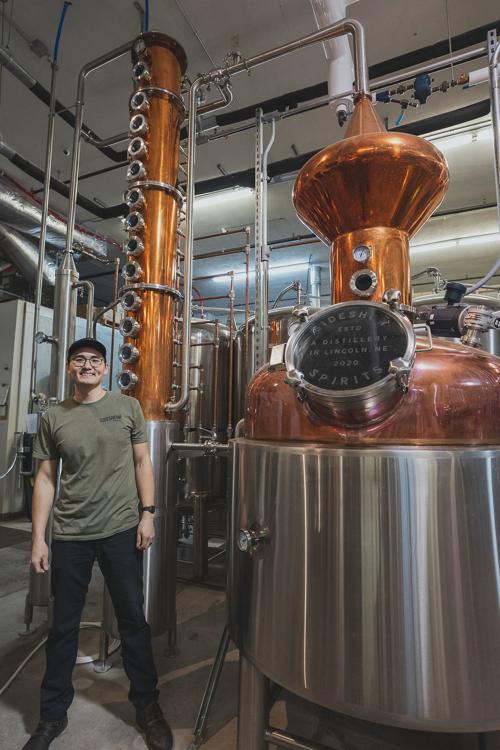
Distilleries 1.JPG

James Reece, head distiller at Sideshow Spirits, stands in front of the 250-gallon custom copper column still.

Like the craft brewing boom of decades past, microdistilleries are taking off in the Midwest, and corn farmers stand to benefit.

For the first time, the Nebraska Corn Board has opted to take part in a national microdistilling competition in an effort to further propel Nebraska’s corn industry.

The contest is expected to kick off sometime this spring, with judging held in Louisville, Kentucky, in July during the Heartland Whiskey Competition.

Participants must use corn as the main ingredient.

Microdistilleries have increased tremendously over the past several years, nearly doubling in number over a four-year period. It's similar to the growth of local wineries and craft brewers.

Nebraska claims 55 craft breweries. In 2019, they had a combined impact of $600 million, according to the Brewer’s Association. Local distillers are hoping to ride that trend. 

Currently, there are seven distilleries operating in Nebraska, with three more in the planning stages.

“So, that’s 10, which has definitely grown, especially in the last five years,” said Zac Triemert, owner and head distiller at Brickway Brewery & Distillery in Omaha's Old Market district since 2013.

Nebraska's first microdistillery opened its doors in 2006 and the growth in the industry has been steady, but not nearly as rapid as with the breweries, Triemert said.

“I expect distilleries to grow at a decent rate, but not as fast as breweries,” he said.

Starting a distillery takes more capital and equipment than a brewery, said Triemert, who earned his master's degree in Scotland in brewing and distilling.

Another Nebraska distillery also grew out of a brewery. Kinkaider Brewing Co. is a community farm craft brewery based in Broken Bow, with locations also in Grand Island and Lincoln.

Lincoln brewer sending its beers to Tennessee

At the Broken Bow brewery, visitors can stay on the farm and enjoy the restaurant and bar. Its Grand Island location focuses more on the restaurant, while the Kinkaider location in Lincoln’s Historic Haymarket has a taproom. Its menu features 30 styles of beer.

The Schmick family, which owns Kinkaider, opened Sideshow Distillery last fall. Sideshow features vodka, whiskey and a soon-to-be released jalapeno vodka. It is also barrel-aging several different bourbons. It uses homegrown Nebraska grains and partners with in-state farms for other ingredients needed to make its beer.

Distilleries 2.JPG

The Sideshow Cocktail Bar offers spirits produced by Lincoln's first legal distillery.

“We purchase all of our corn, rye and wheat locally in Nebraska for the distillery. For the brewery, we buy the honey from McDonald Aviary near Chadron and some of the berries. We also partner with Season View Farms near Lincoln,” said Barry Fox, Kinkaider marketing spokesman.

Triemert also uses Nebraska grain and products.

“I use as much local raw material as possible, but there’s not a very big malting house in Nebraska, which is about 5% of my production,” he said.

With that, he's seeking a good source of Nebraska malted corn, since Brickway is currently creating a lot of bourbon.

Triemert, who is very active in the Nebraska Craft Brewers Guild, helped write the legislation for the state’s craft distilling bill, which passed in the Nebraska Legislature in 2006.

"I wanted to start a distillery in Nebraska,” he said.

Originally, he was permitted to create 21,000 gallons, but the volume was knocked to 10,000, he said. Triemert testified before the Legislature this winter to increase production capability to 100,000 gallons, and he feels confident the Legislature will approve the increase.

“Right now, Nebraska has the smallest cap in 50 states, by half. The next-smallest state has 25,000 gallons," said Triemert, whose brewery and distillery team has won a dozen spirits and beer awards in the last 30 years.

Two Lincoln-area breweries now selling beers at stores

LINCOLN BREWERIES:

The Link Lonk


April 01, 2021 at 09:15AM
https://ift.tt/3cFrmId

Distillery trend puts Nebraska corn growers in high spirits - Lincoln Journal Star

https://ift.tt/3gguREe
Corn

Wednesday, March 31, 2021

French Trademark Major Grape Varieties | Wine-Searcher News & Features - Wine-Searcher

ersa.indah.link

The wine world has been left reeling as France makes a serious 'grape-grab'.

In a stunning move that will have wineries worldwide grappling with the ramifications for years, a French law firm has successfully lobbied its government to formally adopt a form of appellation rights to six individual grape varieties, with more varieties likely on the cards.

While the exact upshot of this is unclear, it effectively grants France property rights over the use of the name of the grape on any bottle worldwide. Just as the word Champagne is regionally designated and protected, so now are Chardonnay, Cabernet Sauvignon, Pinot Noir (as well as Pinot Blanc and Pinot Gris – but not "Pinot Grigio"), Syrah and Sauvignon Blanc.

It is still not known whether or not France will push for an outright international ban of the use of the names of the grape varieties on wine labels or whether it will demand a small fee – effectively a royalty – paid by wineries using those grape names on their labels. The latter is considered by experts to be the most likely option, given the already ubiquitous use of varietal labeling and the potential revenue the French coffers stand to draw.

Talking exclusively to Wine-Searcher, one of the legal team, which initially presented the case to a mixed hearing of the INAO (France's governing appellations body), the DGCCRF (the French anti-fraud bureau) and the Ministry of Agriculture and Food, said there would be a gentle rollout of the plan over the next year.

"Look, in a few cases, there is little to fear," said Jean-Philippe Poisson, one of the lead lawyers with Cabinet Davril, the legal firm which brought the case to the French courts (who is backing the case, however, is unknown). "If you look at names like Shiraz or Meritage, for instance, these are untouchable – although, of course, there is nothing stopping the Australians or the Americans from protecting those terms themselves. We can only wait to see how the government, led primarily by the Ministry of Agriculture, will proceed. We think it is likely there will be some form of royalty payment."

When asked whether this would damage the reputation of France internationally, Poisson was quick to state that his firm was only interested in the protection and defense of France and the country's heritage, or 'patrimoine'.

"These grapes are French," he said. "How long has it taken us to be rid of American 'Chablis' or Australian 'Burgundy'? We are simply doing the same with grapes. It is not the fault of France if our grapes travel well."

"The rest," he added, "is between the French government and the WIPO [the World Intellectual Property Organisation] – we are covered under Madrid, Paris and Lisbon." The latter are founding treaties in international intellectual property and appellations laws.

The impact has the potential to be huge. Indeed, famed Swiss grape geneticist, José Vouillamoz, was unavailable for contact. Wine-Searcher understands his office continues to be inundated with calls.

"They will be getting calls for numerous reasons," one industry insider told Wine-Searcher. "Firstly, people will be asking if it cannot be proved that, say, Syrah isn't actually from Iran or something. The problem is that will only move the problem somewhere else. This is because, secondly, we all need to find out exactly which variety comes from where and not everyone is calling because they're worried – some smell opportunity. Just imagine how many grapes Italy can claim, for instance."

Pinot Grigio is thought to be a potential sticking point although Wine-Searcher understands the French government is likely to leave the variety to Italy. While many European countries will no doubt begin to stake their claims (Spain and Tempranillo, Italy and Nebbiolo, for instance), others, such as Cornalin (a name found in both Switzerland and Italy) will doubtless be the subject of protracted legal wranglings.

One Texan viticulturist, who did not wish to be named, was fuming. Given most vines are planted on rootstock originating from American vines, it might have been possible for the US to capitalize on this new state of affairs. However, few rootstocks carry their original name.

"I mean, we [the USA] could have nipped this all in the butt," he said. "But they had to go and give most all our rootstock a number for a name. I mean, for sure I want the Bureau of Tax and Trade to register 'Riparia' but we ain't got a hope in hell with things like 3309."

While the French ministers and bureaucrats mull their next move, Poisson has confirmed Davril will work with the government on further grapes. "Let's not be cynical – we need to protect Picpoul de Pinet or Len de l'El as much as we do Sémillon, Malbec or Viognier."

He would not be drawn on the contents of the next round of grapes to be so protected. According to one source in the French Agriculture ministry, however, it is unlikely all 'French' grapes will be covered. "Yes, of course," said the source, "we will attempt to protect the likes of Gouais Blanc – more for patriotic reasons than anything [it is parent of numerous French grapes, including Chardonnay, although its origins are far from clear] – but, Madeleine Angevine? Well, the English can have that for free."

One EU official, however, was quick to point out that what is known in England as Madeleine Angevine is, in fact, Madeleine x Angevine 7672, which was bred in Germany. But even greater issues are at stake.

"Sure, an umlaut might be enough for the Germans to protect 'Gewürztraminer' and the French 'Gewurztraminer' but that's not the worst," said the official in Brussels. "Who is going to claim Riesling? My God. It's not like the area between Alsace and the Mosel has a history that is devoid of argument, shall we say."

The French government is expected to make an announcement later today.

The Link Lonk


April 01, 2021 at 03:05AM
https://ift.tt/31yHwge

French Trademark Major Grape Varieties | Wine-Searcher News & Features - Wine-Searcher

https://ift.tt/3eO3jWb
Grape

Corn, soybean markets hit 'limit up' on USDA's lower-than-expected acreage - Successful Farming

ersa.indah.link

U.S. farmers will plant lower corn and soybean acreage than the trade expected, according to the USDA.

As a result, the CME Group’s corn market hit its daily limit up (25¢) trading prices. 

At the close, the May corn futures settled up its daily limit of 25¢ at $5.64 1/2.

July corn futures settled up its daily limit of 25¢ higher at $5.47 1/2.

New crop December corn futures closed up its daily limit of  25¢ at $4.77 1/2.

As a result, corn's daily trade limits will expand to 40¢ tomorrow.
 
May soybean futures finished up its daily limit of 70¢ at $14.36 1/2.

July soybean futures ended up its daily limit of 70¢ higher at $14.27 1/2.

New crop November soybean futures settled up its daily limit of 70¢ at $12.56 3/4.

As a result, the soybean market's daily limits will expand, tomorrow, too $1.05.

May wheat futures closed 16¢ higher at $6.18. 

May soymeal futures settled $25.00 short term higher at $423.20.

May soy oil futures closed 2.46¢ higher at 52.92¢ per pound.

In the outside markets, the NYMEX crude oil market is -1.33 lower (-2.20%) at $59.22. The U.S. dollar is lower, and the Dow Jones Industrials are 42 points higher (+0.13%) at 33,109 points.

Anything above 180.3 million acres breaks the 2017 total acreage record.

In its March Prospective Plantings Report Wednesday, the USDA pegged the 2021 U.S. corn acreage at 91.1 million, compared with the trade’s expectation of 93.2 million and the USDA’s previous estimate from the Outlook Forum in February of 92.0 million.

For soybeans, the USDA sees 2021 acreage at 87.6 million vs. the trade’s expectation of 89.9 million and the USDA’s Outlook Forum estimate of 90.0 million.

All wheat acreage is pegged at 46.6 million vs. the trade’s expectation of 44.97 million and the USDA’s Outlook Forum estimate of 45.0 million.

March 1 Grain Stocks

The USDA estimates both the amount of grain stocks on and off-farm as of March 1.

In its report, the USDA pegged the March 1, 2021, U.S. corn stocks at 7.7 billion bushels vs. the trade’s estimate of 7.76 billion bushels.

For soybeans, March 1 stocks totaled 1.56 billion bushels vs. the trade’s estimate of 1.54 billion bushels.

USDA sees U.S. wheat stocks, as of March 1, at 1.31 billion bushels vs. the trade’ estimate of 1.27 billion bushels.

Trade Response

Jack Scoville, PRICE Futures Group, says that the USDA released a wild report and that the uptrend is back.

"The stocks report was mostly in line with trade guesses, a little less in corn and a little bigger in wheat with soybeans dead-on guesses.  Not much there.  But the Prospective Plantings report was wild, much below trade guesses for corn, beans, and wheat," Scoville says.  

"I'm not sure why the U.S. farmer is not going fencepost to fencepost, but he was not planning to when he was surveyed.  Plus, there was a lot of prevent plant area last year that was expected to get planted this year. So, I am not sure I believe the numbers, but they are what we got and we have to ride with them.  Limit up now and probably locked up for today.  We could be higher tomorrow.  Maybe we go down a bit tomorrow, only to go higher later. The uptrend is back," Scoville says.

Jason Roose, U.S. Commodities, says that today's USDA report is telling the story of tight stocks. 

“Grains are adding back price premium with a flurry, after today's all important USDA Acres and Stocks reports. The acres set the stage with less than anticipated acres for both corn and soybeans. Larger acres are felt to be needed with stocks at multiple-year lows, with a margin of error tight going into spring," Roose says.  

Roose added, "Spring weather will be closely watched and will acres be added in with higher prices, and will exports stay competitive with a stronger dollar,” Roose says.

The Link Lonk


April 01, 2021 at 12:30AM
https://ift.tt/31DsPbT

Corn, soybean markets hit 'limit up' on USDA's lower-than-expected acreage - Successful Farming

https://ift.tt/3gguREe
Corn

Featured Post

Dry conditions decrease Brazilian corn production estimate - World Grain

ersa.indah.link BRASILIA, BRAZIL — Delayed planting and continued dry conditions has dropped Brazil’s estimated corn production 11 million...

Popular Posts